The city
Vienna's Architecture, from Gothic to Hundertwasser: A Guide in Buildings
Tony Denesa – Travel Advisor13 min read
The short version
Few cities let you walk through eight centuries of architecture as easily as Vienna. The historic centre is a UNESCO World Heritage Site, and within a couple of kilometres you pass a Romanesque chapel, a Gothic cathedral, baroque palaces, the grand historicist buildings of the Ringstrasse and the first modern buildings of Europe. Beyond the Ring, the city adds the social housing of Red Vienna, a concrete sculpture of a church and the colourful objections of Friedensreich Hundertwasser.
This guide is organised by period, with the buildings that best explain each one. For history in more depth, read Habsburg Vienna; for the palaces themselves, see our palaces page.
Romanesque and Gothic: the medieval city
St. Rupert's and St. Stephen's
The small, ivy-covered St. Rupert's Church above the Danube Canal is traditionally considered Vienna's oldest church, and its plain Romanesque tower recalls a town that was little more than a trading post on the river.
St. Stephen's Cathedral tells the rest of the Middle Ages in a single building. Its west front, with the Giant's Door and the two Heathen Towers, survives from the Romanesque church; the soaring nave and the South Tower, about 136 metres high, are Gothic. Look up at the roof of glazed tiles laid in zigzags and, on the south side, the double-headed eagle. The climb up the South Tower's 343 steps is the best way to understand the medieval city plan below.
Gothic churches of the court
The Augustinian Church, tucked into the Hofburg, served as the court parish church, where Habsburg weddings took place. The Minoritenkirche, with its sliced-off tower, and the lesser-known Maria am Gestade, with its lace-like stone lantern, complete the Gothic picture.
Baroque: the city after 1683
When the Ottoman army withdrew from Vienna in 1683, the aristocracy no longer needed to crowd inside the walls; the story is in the siege of Vienna. A building boom followed, and Vienna became one of the capitals of the European baroque. Two architects dominated it: Johann Bernhard Fischer von Erlach and Johann Lukas von Hildebrandt.
- Karlskirche: Fischer von Erlach's masterpiece, vowed by Emperor Charles VI during the plague of 1713. Two columns modelled on Trajan's Column in Rome flank a Greek portico and an oval dome — an architectural statement of imperial ambition.
- Upper Belvedere: Hildebrandt's summer palace for Prince Eugene of Savoy, the general who won the wars against the Ottomans, with terraced gardens falling towards the city.
- Schönbrunn Palace: begun to designs by Fischer von Erlach and remodelled under Maria Theresa, whose yellow became the colour of the empire.
- State Hall of the National Library: the Fischer von Erlachs, father and son, created one of the most beautiful library rooms in the world.
- St. Peter's Church: a jewel box of an oval church off the Graben, near the Plague Column, itself a baroque thanksgiving in stone.
The Ringstrasse: history as a style catalogue
In 1857 Emperor Franz Joseph ordered the city walls demolished, and in their place rose a boulevard lined with public buildings, each dressed in the historical style its purpose seemed to call for. This is historicism, and the Ring is its greatest showcase; our article on the Ringstrasse walks it in full.
- Votive Church: neo-Gothic, by Heinrich von Ferstel — thanksgiving for the emperor's survival of an assassination attempt.
- City Hall: neo-Gothic, recalling the free cities of Flanders and civic self-government.
- Parliament: neo-Greek, by Theophil Hansen, for democracy's birthplace.
- Burgtheater and the twin museums, including the Kunsthistorisches Museum: neo-Renaissance and neo-baroque grandeur by Gottfried Semper and Carl von Hasenauer.
- State Opera: the first great building of the Ring, opened in 1869, and criticised so harshly at first that neither of its architects lived to see it succeed.
- Musikverein: Hansen again, in a Greek-inspired style, with its Golden Hall.
- Palais Ferstel: in the Innere Stadt, a Venetian-Florentine palace with an arcade.
Vienna 1900: Secession and Jugendstil
By the 1890s young artists rejected the costume party of historicism. In 1897 they founded the Secession, and in 1898 Joseph Maria Olbrich gave them a white exhibition hall under a dome of gilded laurel leaves: the Secession, with the motto "To every age its art, to art its freedom". The wider world of Klimt, Freud and Mahler is told in Vienna 1900.
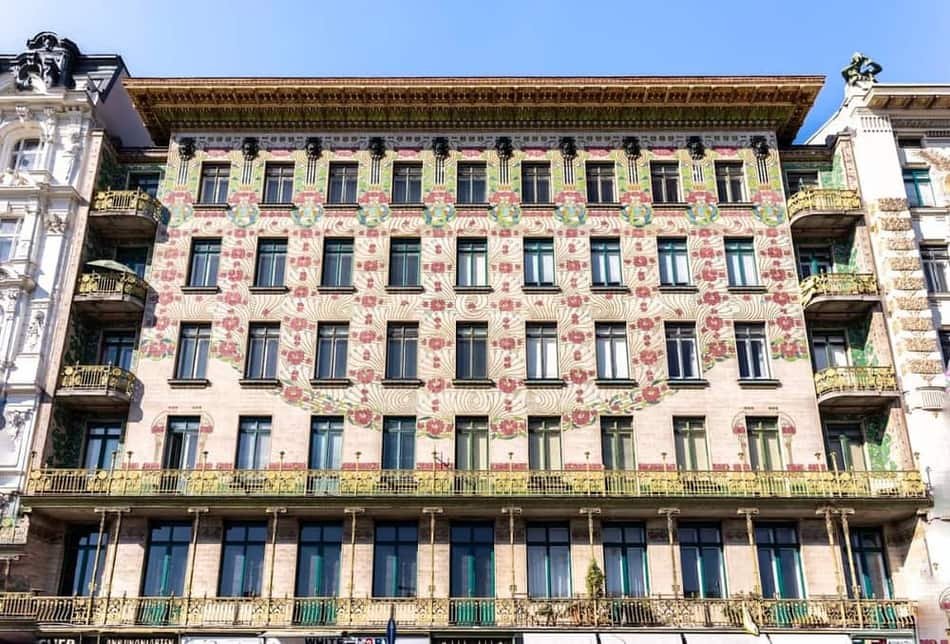
Otto Wagner was the architect who carried Vienna into the modern age.
- Majolikahaus: an apartment house on the Linke Wienzeile, its façade covered in weatherproof ceramic roses.
- Karlsplatz pavilions: green iron and white marble stations for the city railway.
- Postal Savings Bank: a banking hall of glass and aluminium, with visible rivets on the façade — function turned into ornament.
- Church am Steinhof: a golden-domed church for a psychiatric hospital, designed for hygiene and light.
Our Jugendstil walk links these on foot. Wagner's rival in spirit was Adolf Loos, who condemned ornament. His Looshaus on Michaelerplatz, facing the Hofburg, caused a scandal for its plain upper façade, and he designed the sober interior of Café Museum in 1899.
Red Vienna: architecture as social policy
Between the world wars, the Social Democratic city built tens of thousands of council flats around courtyards with kindergartens, laundries and libraries. The most famous is the Karl-Marx-Hof in Heiligenstadt, a fortress-like block roughly a kilometre long. Read Red Vienna for the story.
After 1945: concrete, colour and glass
- Wotruba Church: a sculpture of stacked concrete blocks by the sculptor Fritz Wotruba, on a hill in Liesing.
- Haas-Haus: Hans Hollein's curved glass building opposite St. Stephen's reflects the cathedral — hated when it opened, now a landmark.
- Hundertwasser House: a council block with uneven floors, onion domes and trees on the terraces; see it from outside, then visit the Kunst Haus Wien.
- Gasometers: four brick gas tanks converted into flats, offices and a shopping mall.
- MuseumsQuartier: the former imperial stables, with the white cube of the Leopold Museum and the dark basalt block of the mumok added in the courtyard.
- Donau City: the towers across the Danube, among them Austria's tallest skyscraper, show the city's 21st-century face.
A note on heritage
The historic centre was inscribed on the UNESCO World Heritage List in 2001, and has been on the List of World Heritage in Danger since 2017 because of a planned high-rise project near the Stadtpark. The debate between preservation and growth is itself part of Vienna's architectural story. Start your walk in the Innere Stadt.
Where to stay nearby
Live prices and availability on a map centred on this exact spot — hotels, apartments and hostels, so you can judge the walk from here rather than guess from an address.
Bookings made through this map earn us a commission. Your price is unaffected.