Blog
The Ringstrasse: The Boulevard That Replaced Vienna's Walls
Tony Denesa – Travel Advisor11 min read
The short version
The Ringstrasse is the horseshoe-shaped boulevard, some five kilometres long and around 57 metres wide, that wraps the old centre of Vienna and meets the Danube Canal at both ends. Until the 1850s this line was a belt of bastions, moats and an empty glacis. In December 1857 Emperor Franz Joseph ordered the fortifications demolished; over the following half-century the land was filled with an opera house, a parliament, a city hall, a university, two giant museums, theatres, churches and the apartment palaces of the new industrial and banking elite. It is the most complete ensemble of nineteenth-century historicist architecture in Europe, and it still frames everything a visitor does in the Innere Stadt.
Why Vienna kept its walls so long
Most European capitals lost their medieval walls well before 1850. Vienna held on, partly out of memory: the fortifications had stopped the Ottoman armies in 1529 and again in 1683 (the story is told in The Siege of Vienna 1683). By the nineteenth century they were militarily useless — Napoleon's troops took the city twice, in 1805 and 1809, and blew up part of the bastions near the Hofburg on their way out. The gap they left became the Volksgarten and the Burggarten, the first hint of what was to come.
The real reason for delay was political. After the revolution of 1848, when Viennese students and workers briefly held the city, the army wanted open ground between the old town and the suburbs where the "dangerous classes" lived. The glacis — a wide field of fire several hundred metres deep — suited the generals perfectly. What changed their minds was money, growth and a young emperor who wanted a capital to match his empire.
"It is my will": the decree of 1857
The imperial handwritten order, opening with the famous words *"Es ist mein Wille"*, is dated 20 December 1857 and was published in the official Wiener Zeitung on Christmas Day. Demolition began in March 1858. An international competition produced several prize-winning plans, and the master plan approved in 1859 combined their ideas. The street was formally opened on 1 May 1865, though building went on for decades.
The financing was clever. A City Expansion Fund sold the former military land in plots to private developers, and the proceeds paid for the public buildings. The army still got its way in part: new barracks such as the Rossauer Kaserne went up at the edges, and the boulevard itself was wide enough to move troops and artillery quickly. Beauty and crowd control were never far apart on the Ring.
A walk around the Ring, building by building
The best way to understand the Ringstrasse is to follow it clockwise from the Opera. Trams 1 and 2 run along long stretches of it if your feet give out (check the current routes on the getting around page).
The State Opera (Sicardsburg and van der Nüll, opened 25 May 1869 with Mozart's *Don Giovanni*) was the first great public building to be finished — and the most mocked. Critics said it looked sunk into the ground because the street level was raised after construction started. Eduard van der Nüll took his own life in 1868; August Sicard von Sicardsburg died weeks later. Neither saw the opening. The Viennese legend that Franz Joseph afterwards limited his comments on any building to a polite "it was very nice, I was very pleased" is widely told and hard to prove. Visit the Vienna State Opera on a guided tour by day, or read our concerts page for performances.
The Kaiserforum. Across from the Hofburg, Gottfried Semper and Carl von Hasenauer designed an imperial forum that was never finished. What exists is spectacular: the twin museums facing each other across Maria-Theresien-Platz — the Kunsthistorisches Museum (opened 1891) and the Natural History Museum (opened 1889) — and the curved wing of the Neue Burg, completed only in 1913. A matching wing on the other side of Heldenplatz was never built, which is why the square feels so strangely open. The two equestrian statues there, of Archduke Charles and Prince Eugene, are by Anton Dominik Fernkorn.
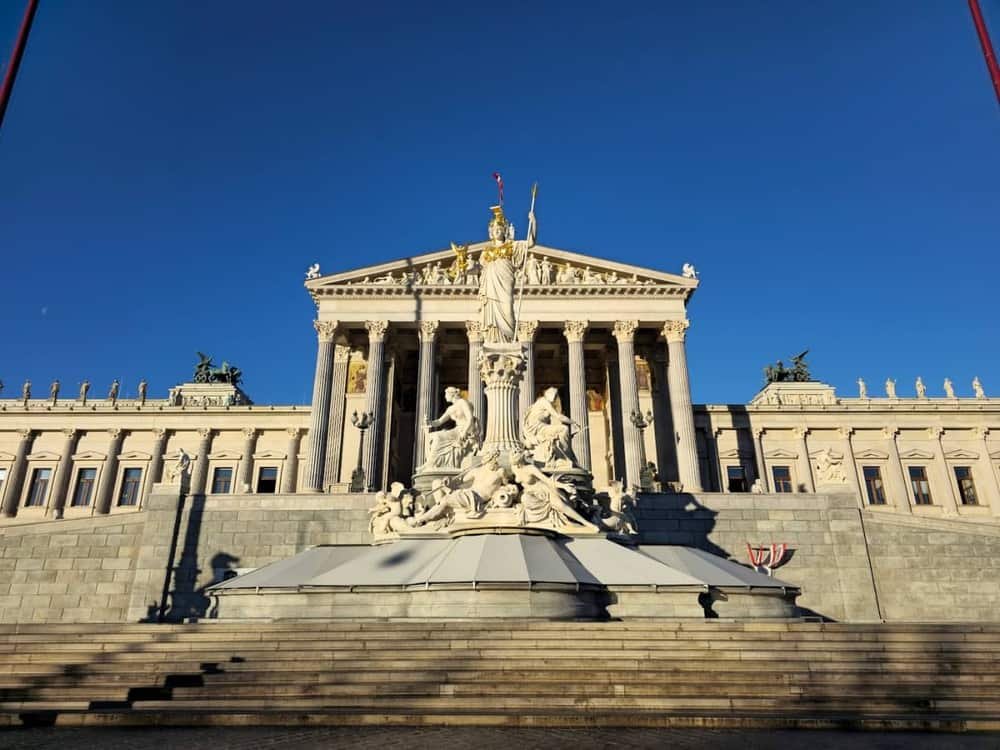
Parliament, City Hall, University, Burgtheater. The next stretch is a lesson in how the nineteenth century used style as argument. Theophil Hansen gave the Austrian Parliament (1874–1883) Greek columns and an Athena fountain because Athens stood for democracy. Friedrich von Schmidt made the City Hall (1872–1883) neo-Gothic, recalling the self-governing merchant towns of Flanders. Heinrich von Ferstel chose the Renaissance for the University of Vienna (1884), the age of humanist learning. Facing the Rathaus, the Burgtheater by Semper and Hasenauer opened in 1888 in a neo-Baroque that flattered the court. Behind the university, Ferstel's twin-spired Votive Church thanks God for Franz Joseph's survival of a knife attack in 1853; it was consecrated in 1879. The Parliament reopened in 2023 after a long restoration and is one of the most rewarding free visits on the Ring.
Schottenring to Stubenring. North of the university the Ring turns commercial: Hansen's red-and-cream Stock Exchange, and the building he designed as a hotel for the 1873 World Exhibition, now the Anantara Palais Hansen. On the eastern side, Ferstel's Museum of Applied Arts (1871) is a fine brick-and-sgraffito palace, and across the street stands the building that declared the Ringstrasse style finished: Otto Wagner's Postal Savings Bank (1904–1906, extended 1910–1912), with its aluminium bolts and glass-roofed banking hall. Continue into the Stadtpark, opened in 1862, to find the gilded Johann Strauss monument of 1921.
The palaces of new money
The public buildings get the postcards, but most of the Ring is private: grand apartment blocks the Viennese call *Ringstrassenpalais*. Their owners were industrialists, bankers and railway builders — the "Ringstrasse barons" — many from families that had only recently won full civil rights, including prominent Jewish families such as the Ephrussi, Todesco and Epstein. Hansen's Palais Ephrussi on the Universitätsring is the house of Edmund de Waal's memoir *The Hare with Amber Eyes*; Palais Epstein, next to Parliament, is now part of the parliamentary complex. Many of these families were robbed and driven out in 1938 — the story continues in Vienna 1938–1955 and Jewish Vienna.
Luxury hospitality followed wealth. The Hotel Imperial began as the palace of Duke Philipp of Württemberg and became a hotel for the 1873 exhibition; the Hotel Bristol opened opposite the Opera in 1892. The café culture of the boulevard is still alive at Café Schwarzenberg (1861), Café Landtmann (1873) and Café Prückel (1903) — see our coffee houses guide.
The critics: Sitte, Loos and the "Potemkin city"
The Ring had enemies from the start. The planner Camillo Sitte argued in 1889 that its vast spaces made people feel lost, and that good squares should be enclosed. The architect Adolf Loos was crueller: in his 1898 essay *The Potemkin City* he mocked apartment houses dressed up with nailed-on cement ornament to look like aristocratic palaces. Otto Wagner, who built on the Ring himself, called for architecture that expressed modern life instead of borrowing costumes from history. Their rebellion is the subject of our Vienna 1900 and Jugendstil walk. The historian Carl Schorske later read the Ringstrasse as the self-portrait of Austrian liberalism: confident, cultured and, as the next decades proved, fragile.
What the Ring means today
The Ringstrasse is part of the Historic Centre of Vienna, a UNESCO World Heritage Site since 2001 (placed on the List of World Heritage in Danger in 2017 over a high-rise project near the Stadtpark). It is also where the city gathers: marathon runners, the Rainbow Parade, demonstrations, New Year crowds. It is also where history turned darkest: on 15 March 1938 Hitler addressed a vast crowd on Heldenplatz from the terrace of the Neue Burg.
How to see it well: walk one half and ride the other; go inside at least three buildings (Parliament, the Opera on a tour, and a museum); take coffee on the Ring rather than beside it; and come back at night, when the façades are lit. For the dynastic background, read Habsburg Vienna; for the palaces beyond the boulevard, see palaces.
Where to stay nearby
Live prices and availability on a map centred on this exact spot — hotels, apartments and hostels, so you can judge the walk from here rather than guess from an address.
Bookings made through this map earn us a commission. Your price is unaffected.