
Blog
The Sachertorte Story: Sacher vs Demel, and Which to Eat
Tony Denesa – Travel Advisor10 min read
The short version
The Sachertorte is a dense chocolate sponge with a thin layer of apricot jam and a shiny dark chocolate glaze, served with a cloud of unsweetened whipped cream. According to the Sacher family, it was invented in 1832 by Franz Sacher, a sixteen-year-old kitchen apprentice in the household of Prince Metternich. His son Eduard refined it, founded the Hotel Sacher in 1876 and, before that, trained at the court confectioner Demel. A century later the two houses fought for years over who could sell the "genuine" cake, and the dispute ended with a settlement in the early 1960s. Today you can eat the Original Sacher-Torte at Café Sacher behind the Opera, or the Eduard-Sacher-Torte at Demel on Kohlmarkt. Both are good. Neither is the best cake in Vienna. Here is the story, and the honest verdict.
1832: an apprentice and a prince's dinner
Vienna in 1832 was the city of the Congress system and of Klemens von Metternich, the most powerful statesman in Europe. The tale told by the Sacher house goes like this: Metternich wanted a new dessert for important guests, his head chef was ill, and the task fell to the young apprentice Franz Sacher. He produced a chocolate cake glazed in chocolate, and the guests were pleased.
It is a lovely story, and it may well be true in outline. But be aware that it comes largely from the family itself, told decades later, and that chocolate cakes with jam were not unknown in Central European cookbooks before 1832. What is not in doubt is that Franz Sacher went on to a successful career as a cook and delicatessen owner, and that the cake bearing his name became a Viennese institution through his son.
Eduard, Anna and the Hotel Sacher
Eduard Sacher trained as a pastry cook at Demel, then the imperial and royal court confectioner (*k.u.k. Hofzuckerbäcker*), and is generally credited with giving the cake the form we know. In 1876 he opened the Hotel Sacher directly behind the new State Opera, and the cake became its signature.
After Eduard's death in 1892 his widow, Anna Sacher, ran the hotel for almost four decades and made it legendary: a cigar-smoking hostess with French bulldogs, discreet private dining rooms (*chambres séparées*) for archdukes and their companions, and a famously sharp sense of who deserved credit and who did not. The hotel's guestbook and its tablecloth embroidered with the signatures of famous guests are part of the lore. Anna died in 1930. Within a few years, in the economic crisis of the 1930s, the hotel went bankrupt and passed to new owners, the Gürtler family, who still own it.
The Sachertorte war
This is where it gets complicated, and where you should treat any single version with caution. Anna's son, also named Eduard, went to work for Demel and brought with him the family's rights and knowledge of the recipe, and Demel began to sell its cake as the genuine Sachertorte. The new owners of the Hotel Sacher also sold it as the original. After the Second World War the two houses fought it out in the courts from the 1950s — a dispute Austrians still call the "Sweet Seven Years' War".
The quarrel ended in an out-of-court settlement in the early 1960s. The Hotel Sacher won the exclusive right to the name "Original Sacher-Torte", marked by a round chocolate seal. Demel sells its version as the "Eduard-Sacher-Torte", marked with a triangular seal. The famous technical difference that the courts and newspapers loved: the hotel's cake has a layer of apricot jam in the middle as well as under the glaze, while Demel's has jam only under the glaze. Plenty of people cannot tell the difference blindfolded, which has never stopped anyone arguing about it.
Demel: the court confectioner
Demel's own history goes back to 1786, when a confectioner opened a shop on Michaelerplatz, opposite the old Burgtheater that then stood beside the Hofburg. The business passed to the Demel family in the nineteenth century and moved in 1857 to its present address on the Kohlmarkt, the elegant street that runs straight into the Hofburg. As purveyor to the court it supplied the imperial household, and the shop still wears the *k.u.k. Hofzuckerbäcker* title like a family crest. In the twentieth century it had a colourful run of owners — including, in the 1970s and 1980s, a notorious one tied to a major political scandal — and since 2002 it has belonged to the Austrian catering group Do & Co.
Go for the interior as much as the cake: mirrored rooms, dark wood, a window where you can watch the pastry cooks, and the long glass counters of cakes and sweets at the entrance. Demel's candied violets and its beautifully boxed chocolates make better souvenirs than most things on Kärntner Strasse.
How to eat a Sachertorte properly
- Always with whipped cream. Ask for it *mit Schlag*. The unsweetened *Schlagobers* is not decoration; the cake is deliberately dense and not very sweet inside, and the cream supplies the moisture.
- With coffee, ideally a Melange or an *Einspänner*. Our coffee house etiquette guide explains the menu.
- Room temperature, not cold from a fridge — the glaze should snap slightly and the jam should taste of fruit.
- Take one home. Both houses sell whole cakes in wooden or decorated boxes that travel well for a couple of weeks. The official Sachertorte day in Austria is 5 December.
The honest verdict
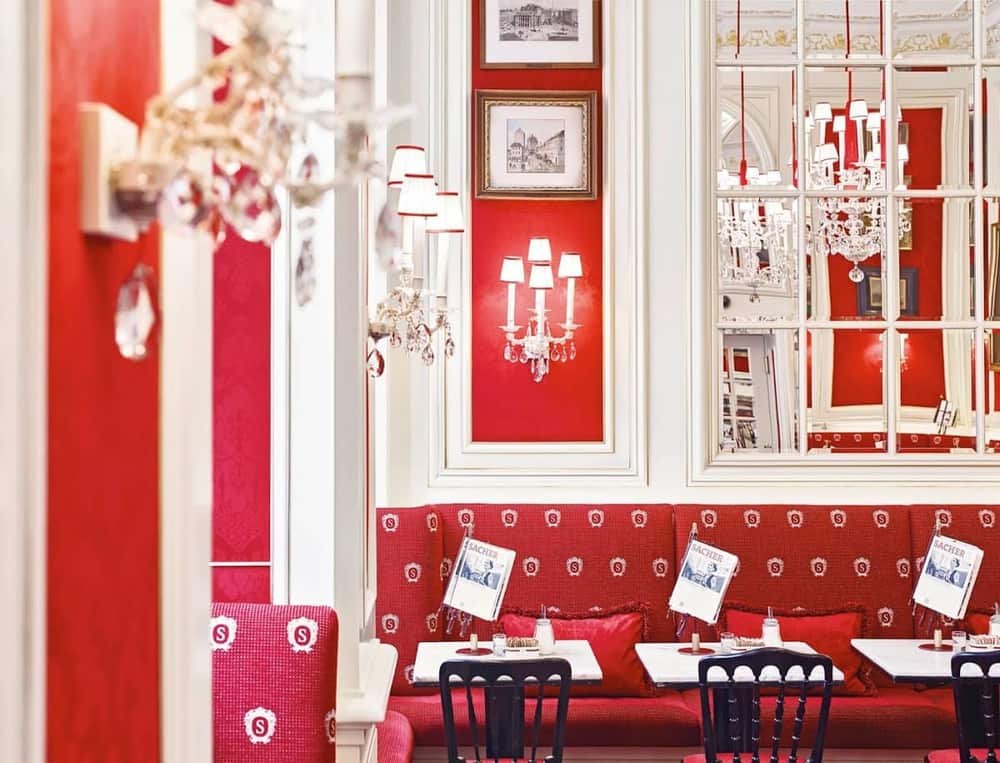
If this is your first visit to Vienna, eat one Sachertorte at Café Sacher. The red damask, the chandeliers, the waiters in black and the sense of occasion are the point; you are paying for a room and a ritual as much as a slice. Expect a queue at peak afternoon hours. It is usually shorter in the morning or late in the evening; the café's published hours were daily 07:00–23:00 when we checked the Sacher website in September 2026. If the queue is long, the Sacher shop next door sells the same cake boxed to take away.
At Demel (daily 10:00–19:00 as listed on demel.com, September 2026), the setting is more intimate and the counter tempts you away from the Sachertorte altogether — which is not a bad thing.
And the truth that most Viennese will tell you: the Sachertorte is an icon, not necessarily the most delicious cake in town. It is, by design, a keeping cake. For something lighter or more exciting, try a Punschkrapfen, an Esterházy-Torte or a seasonal strudel at a classic Konditorei such as Gerstner opposite the Opera, Aida, or the Kurkonditorei Oberlaa. For a rival hotel legend, Café Imperial at the Hotel Imperial sells its square, marzipan-wrapped Imperial Torte.
The cake in the bigger picture
The Sachertorte belongs to a long Viennese tradition of dessert as status. Court confectioners competed for the imperial warrant, the rising bourgeoisie of the nineteenth century copied the aristocracy's sweets, and the coffee house turned cake into an everyday luxury anyone could afford for an afternoon. That story is told in our history of the Viennese coffee house and in the origins of Viennese cuisine, a kitchen built from Bohemian, Hungarian, Italian and Balkan influences. For the rest of what to order in the city, from schnitzel to Tafelspitz, see what to eat in Vienna, and browse all our coffee houses in the Innere Stadt and beyond.
Where to stay nearby
Live prices and availability on a map centred on this exact spot — hotels, apartments and hostels, so you can judge the walk from here rather than guess from an address.
Bookings made through this map earn us a commission. Your price is unaffected.