The city
Vienna Wine History: Vineyards in a Capital, from Rome to Gemischter Satz
Tony Denesa – Travel Advisor11 min read
The short version
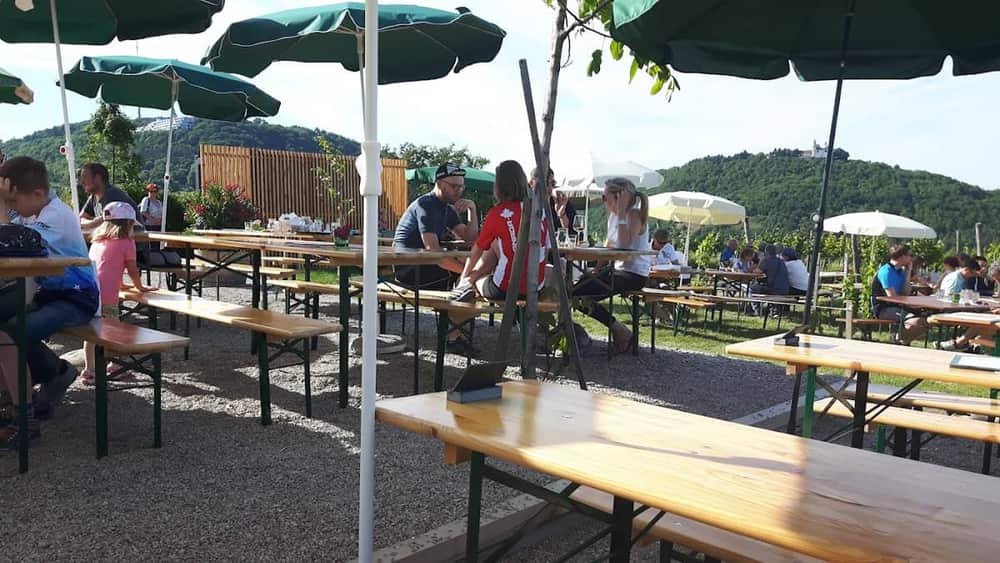
Vienna has roughly 600 hectares of vineyards inside the city limits, according to the Vienna wine board, and likes to call itself the only major capital with significant wine production. Vines grow on the slopes of the Kahlenberg and Nussberg in Döbling, on the Bisamberg in Floridsdorf, and around Mauer in Liesing, close enough to the centre that you can reach them by tram and bus. The tradition runs from Roman Pannonia through medieval monasteries and a 1784 decree of Joseph II, which gave rise to the Heuriger, the wine tavern where growers pour their own wine. It survived phylloxera and the Austrian wine scandal of 1985, and today its flagship is the Wiener Gemischter Satz, a field blend of several white grape varieties grown and harvested together. This is the story, and how to drink it on the spot. For the practical side, read our Heuriger guide and browse the Heurigen listings.
Romans, monks and a city of vineyards
Vines were grown along the Danube in Roman times, when Vindobona was a military camp on the frontier of the province of Pannonia. Local tradition credits Emperor Probus (reigned 276–282) with encouraging viticulture in the region, which is why a street in Heiligenstadt is called Probusgasse. The link is more legend than documented fact, but wine-growing here is certainly ancient.
In the Middle Ages, monasteries became the great wine producers. Klosterneuburg Abbey, founded in the early twelfth century just beyond today's city border, is still one of Austria's important estates, and abbeys such as Melk kept cellars inside Vienna to sell their wine. Vineyards then reached much closer to the centre than today, covering slopes that are now residential districts. Wine was part of the city's economy, its taxes and its diet. A much-repeated story says that the vintage of 1450 was so sour that it was used to mix mortar for building St. Stephen's Cathedral. It is a good tale; treat it as one.
The old monastic and noble wine cellars survive in the centre as atmospheric wine taverns: the Melker Stiftskeller, the deep Zwölf-Apostelkeller near St. Stephen's, and the Esterházykeller, which claims its doors first opened to the city's defenders during the siege of 1683. Take the founding legends lightly and the vaulted rooms seriously.
1784: the decree that created the Heuriger
The most important date in Viennese wine culture is 17 August 1784. That year Joseph II, the reforming emperor described in Maria Theresa and Joseph II, issued a decree allowing wine-growers to sell wine and simple food from their own production directly to customers at home, without a special licence. Growers announced that they were open by hanging a bundle of pine or fir branches over the door and putting up a sign saying "Ausg'steckt" — both customs still in use.
The word *heuriger* means "this year's". It refers both to the young wine of the latest vintage, which may be sold as such until St Martin's Day on 11 November, and to the tavern where it is served. Strictly speaking a Buschenschank is a tavern operating under the traditional rules, with its own wine and cold food only, while many larger Heurigen have full restaurant licences and serve hot dishes and beer; in Vienna the words are used loosely. The Viennese Heuriger culture is now on Austria's national inventory of intangible cultural heritage under the UNESCO convention.
Schrammel music and the nineteenth-century excursion
As Vienna grew in the nineteenth century, the wine villages of Grinzing, Nussdorf, Sievering and Neustift became favourite Sunday excursions. People came by horse tram and later by electric tram and railway to sit under the trees, eat from the buffet and drink the new wine. Beethoven had already spent summers here: the house where he lived in 1817 is now the Mayer am Pfarrplatz Heuriger, and the Beethoven Museum is a short walk away.
The music came from the brothers Johann and Josef Schrammel, who founded a trio in 1878 with violins and guitar, later adding a clarinet or accordion. Schrammelmusik and the sentimental, witty *Wienerlied*, the Viennese song, became the soundtrack of the Heuriger, full of wine, death and nostalgia for an old Vienna that was already disappearing. Live music is rarer today, but some taverns still keep it on certain evenings.
Phylloxera, cities and quantity
In the 1870s the vine louse phylloxera, which had already ravaged France, reached Austria. Over the following decades it destroyed most of the old vineyards, which had to be replanted on resistant American rootstocks. At the same time the city spread outwards and swallowed wine villages: Döbling, Grinzing and the others were incorporated into Vienna in 1892. Many vineyards became building land.
For much of the twentieth century Viennese wine was mainly something to drink by the jug in a Heuriger — pleasant, cheap, unpretentious and rarely taken seriously outside the city. Austrian wine in general was often produced for quantity and sold in bulk.
1985: the scandal that changed everything
In 1985 it emerged that some Austrian producers and traders had added diethylene glycol to wines to make them taste sweeter and richer, mostly for the export market. The scandal became international news, exports collapsed and Austrian wine's reputation was destroyed almost overnight. The response was one of the strictest wine laws in Europe and a generation of producers who bet everything on quality: lower yields, careful vineyard work, clean and precise wines. Austria's current reputation for world-class dry whites is, in a real sense, a product of that disaster.
The rebirth of Gemischter Satz
Vienna's answer to the quality revolution was to revive an old habit. Traditionally, Viennese vineyards were planted with many grape varieties mixed together, harvested on the same day and fermented together. This Gemischter Satz spread the risk — if one variety failed, others succeeded — and produced complex, food-friendly wines. In the late twentieth century it was seen as old-fashioned. From the 1990s and 2000s a group of ambitious Viennese growers, among them Wieninger, Mayer am Pfarrplatz, Edlmoser, Zahel, Christ and Fuhrgassl-Huber, championed it as the city's distinctive wine.
Since the 2013 vintage Wiener Gemischter Satz DAC has been a protected designation. According to the rules published by the Vienna wine board, it must come from at least three white quality varieties planted together in a single Viennese vineyard and harvested and vinified together — it is not a blend of separately made wines. The largest variety may make up no more than half, and the third-largest must be at least ten per cent. Typical partners include Grüner Veltliner, Riesling, Weissburgunder, Neuburger and aromatic varieties such as Traminer.
Vineyards as a protected landscape
What makes Vienna's wine unusual is not only its quality but its setting. Vineyards form part of the city's green belt and are protected by planning rules, so the slopes of the Nussberg and Kahlenberg remain agricultural land with views over the whole city. The city itself owns a winery, Weingut Cobenzl, on the hills above Grinzing. On a clear evening at Wieninger am Nussberg, with a glass in hand and the spire of St. Stephen's in the distance, it is easy to understand why the Viennese defend this landscape so fiercely.
How to taste the history today
- Go to the source. Take the tram or bus to Nussdorf, Grinzing, Neustift am Walde or Stammersdorf, where the Stammersdorfer Kellergasse lines a country lane with cellars. Look for the pine bush and the "Ausg'steckt" sign: most family Heurigen open only on rotating dates, published in the monthly calendar on wienerwein.at.
- Walk the vineyards. The Wiener Weinwandertag, the city's wine hiking weekend, takes place on 26–27 September 2026, 10:00–18:00, with free entry and several routes through Döbling, Floridsdorf, Mauer and Ottakring (as announced on the City of Vienna website, checked September 2026). The Kahlenberg and the Höhenstrasse are beautiful in any season.
- Follow the calendar. Late summer and autumn bring *Sturm*, the cloudy, half-fermented young wine sold for a few weeks around harvest. On 11 November, St Martin's Day, the new wine is blessed, the previous vintage stops being "heuriger", and restaurants serve roast goose. See Vienna in autumn and our events calendar.
- Order properly. In a Heuriger, ask for a *Viertel* (a quarter litre) or an *Achtel* (an eighth), or a *G'spritzter*, wine with soda water. The buffet is part of the ritual; the dishes are traced in the origins of Viennese cuisine.
- Visit the sparkling cellars. Austria's sparkling wine tradition is represented in Vienna by the Schlumberger cellars in Heiligenstadt, which offer guided visits.
Wine here is not an attraction you tick off but a way the city relaxes. Give it a long evening, preferably outdoors, and let the history come with the second *Viertel*.
Where to stay nearby
Live prices and availability on a map centred on this exact spot — hotels, apartments and hostels, so you can judge the walk from here rather than guess from an address.
Bookings made through this map earn us a commission. Your price is unaffected.