Guides
The Heuriger Guide: How Vienna's Wine Taverns Work and Where to Go
Tony Denesa – Travel Advisor10 min read
The short version
Vienna is a wine capital in the literal sense: around 600 hectares of vineyards lie inside the city limits, according to the Vienna wine growers' association, and the tourism board calls it the only major city in the world with significant wine production. The place to taste that wine is a Heuriger — a tavern run by a winemaker, serving his or her own wine, often in a garden among the vines. The Heurigen tradition is listed, together with the coffee house, on Austria's national inventory of intangible heritage (wien.info, checked September 2026).
- Where: mostly on the city's edges — Grinzing, Nussdorf, Heiligenstadt, Sievering and Neustift am Walde in the 19th district; Stammersdorf and Strebersdorf across the Danube in the 21st; Mauer in the 23rd; Ottakring and Hernals in the west.
- How to tell it is open: a bundle of pine or fir branches hung over the gate and a sign reading "Ausg'steckt".
- What to drink: the house white, very often Wiener Gemischter Satz, by the quarter litre.
- What to eat: a self-service buffet of cold and warm dishes, paid at the counter.
- When: many family Heurigen open only for a few weeks at a time on rotating dates — always check before you set off.
What exactly is a Heuriger?
The word has two meanings. It is the young wine of the latest vintage, which can be called "heuriger" until 11 November, St Martin's Day. And it is the tavern where that wine is poured. The tradition goes back to the right of winegrowers to sell their own produce directly.
Strictly, there are two kinds of establishment. A Buschenschank, under Austria's Buschenschank rules, may serve only cold dishes and its own wine and drinks made on the estate — juice, cider, schnapps. A tavern with a full restaurant licence may also serve hot food and beer. In Vienna the terms are used almost interchangeably, and the famous names in Grinzing are usually the second kind, with warm roasts and a large menu.
The pine bush and "Ausg'steckt"
Because most family estates cannot open all year, they take turns. A Heuriger that is open hangs a bound pine bush (Föhrenbuschen) over its gate — it is "ausg'steckt", literally "hung out". No bush, no wine. The Vienna wine growers publish a monthly calendar, "Ausg'steckt is", on wienerwein.at, listing who is open when. Larger Heurigen with restaurant licences keep regular hours; smaller ones may be open only two or three weeks a month.
How a Heuriger works
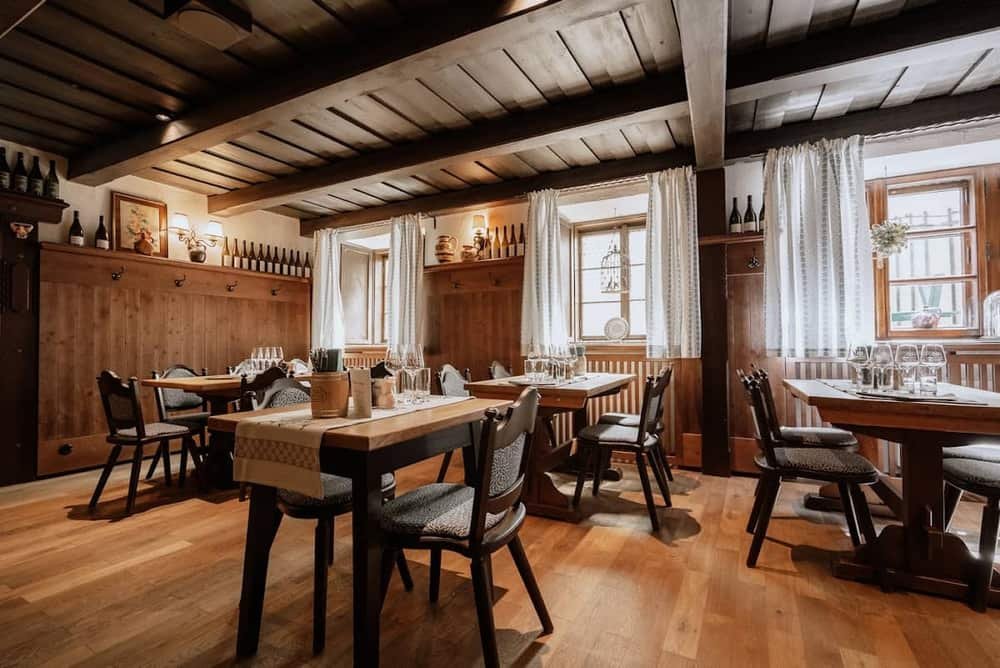
- Find a table. In the garden if the weather allows, otherwise in the rustic rooms with wooden benches. Tables are often shared on busy evenings — ask "Ist hier frei?".
- Go to the buffet. Choose from the display and pay at the counter. Food is sold by the portion or by weight.
- Order wine at the table. A waiter comes to take drink orders; the wine arrives in a glass mug or stemmed glass by the eighth or quarter litre.
- Pay the waiter for drinks when you leave, rounding up as in any Vienna restaurant.
At the simplest Buschenschanken you may be allowed to bring bread or a snack; at the larger places you should not. When in doubt, eat from the buffet.
What to order
- Ein Viertel — a quarter litre of wine; ein Achtel — an eighth.
- G'spritzter — wine with soda water, the summer drink of Vienna. Ask for it "sauer" (with plain soda) rather than sweet.
- Wiener Gemischter Satz — the city's signature white (see below).
- Sturm — in early autumn, partially fermented grape must, cloudy, sweet and deceptively strong.
- At the buffet: Liptauer (spiced cheese spread), Verhackert (a pork-fat spread for bread), cold roast pork, black pudding (Blunzn), vegetables preserved in vinegar, gherkins, and strudel for dessert.
Wiener Gemischter Satz
Vienna's own appellation, Wiener Gemischter Satz DAC, has existed since 2013. The rules, as published by the Vienna wine growers: at least three white quality grape varieties grown together in the same Viennese vineyard, harvested and vinified together — a field blend, not a blend of separate wines. No variety may make up more than 50%, and the third-largest must reach at least 10%. The result is typically fresh, aromatic and very food-friendly. Most Heurigen pour a simple Gemischter Satz by the glass; the top estates also bottle single-vineyard versions worth buying to take home.
Where to go: the wine villages
Heiligenstadt and Nussdorf (19th)
The most convenient start. Mayer am Pfarrplatz occupies the house on Pfarrplatz where Beethoven lived in 1817 while working on his Ninth Symphony — a large, historic Heuriger with a courtyard garden. Higher up, on the Nussberg vineyard slopes, wine stands such as Wieninger am Nussberg and Mayer am Nussberg offer a glass with a view over the Danube and the city on fine days.
Grinzing (19th)
The best-known Heuriger village — and the most touristic. Coaches arrive in the evening, and some of the large houses on the main street cater to groups with accordion music. Walk a little further for character: Hengl-Haselbrunner on the Iglaseegasse and Reinprecht on the Cobenzlgasse are established family names. Above the village, the city-owned Weingut Cobenzl looks out over its own vineyards. The Grinzing page has the village in detail.
Neustift am Walde and Sievering (19th)
Quieter and greener, where the city meets the Vienna Woods. Fuhrgassl-Huber is a large, classic Heuriger with a garden — an ideal place for a long summer evening.
Stammersdorf and Strebersdorf (21st)
Across the Danube, at the foot of the Bisamberg, lies the most rural wine area in the city. The Stammersdorfer Kellergasse, a lane of old press houses and cellars, is lovely on a September afternoon. Heuriger Wieninger on the Stammersdorfer Straße belongs to one of Vienna's best-known wine families; Weingut Christ in nearby Jedlersdorf is another respected producer.
Mauer, Ottakring and elsewhere
In the south-west, Zahel on the Maurer Hauptplatz is a well-known estate. In the west, 10er Marie in Ottakring presents itself as the oldest Heuriger in the city.
See the full list on our Heurigen page and the districts of Döbling, Floridsdorf and Liesing.
Getting there
- Heiligenstadt / Grinzing: U4 to Heiligenstadt, then a short bus ride to Pfarrplatz or Grinzing. The Kahlenberg bus continues up to the viewpoint.
- Nussdorf: tram D from the Ring runs out to Nussdorf, close to the vineyard paths.
- Stammersdorf: reachable by public transport via Floridsdorf; plan the connection in the WienMobil app.
- Coming back: the U-Bahn runs all night on Friday and Saturday nights, and NightLine buses cover the other nights. Do not drive — Heuriger evenings are long.
The best time to go
Heurigen are at their best from late spring to October, when the gardens are open. September and October bring the harvest, Sturm and the most beautiful light in the vineyards. The big event of the year is the Wiener Weinwandertag, the Vienna Wine Hiking Day: Saturday 26 and Sunday 27 September 2026, 10:00–18:00, free (City of Vienna, checked September 2026). Routes run from Neustift via Sievering and Cobenzl to Nussdorf (the longest, with 28 stations), from Strebersdorf to Stammersdorf, and in Mauer and Ottakring. See our events calendar.
In winter many small Heurigen close, though the larger ones stay open.
A walk and a glass: a classic afternoon
Take the bus up to the Kahlenberg for the view over the city, walk down through the vineyards of the Nussberg, stop at a wine stand, and finish with dinner at a Heuriger in Nussdorf or Heiligenstadt. It is the most Viennese afternoon there is, and it fits neatly into three days in Vienna. For the story of wine in the city, read Vienna wine history.
Where to stay nearby
Live prices and availability on a map centred on this exact spot — hotels, apartments and hostels, so you can judge the walk from here rather than guess from an address.
Bookings made through this map earn us a commission. Your price is unaffected.