The city
Maria Theresa and Joseph II: The Reforms That Shaped Vienna
Tony Denesa – Travel Advisor12 min read
The short version
Maria Theresa (1717–1780) inherited the Habsburg lands in 1740 at twenty-three, with an empty treasury, a weak army and half of Europe ready to carve up her inheritance. She survived eight years of war, lost rich Silesia to Prussia, and responded by rebuilding the state: a central administration, a professional army, a tax system and, in 1774, compulsory primary schooling. Her eldest son Joseph II (1741–1790), co-ruler from 1765 and sole ruler from 1780, pushed much further and much faster: religious toleration, the end of serfdom, the closing of hundreds of monasteries, a great public hospital, and the opening of the imperial parks to everyone. Much of what a visitor sees in Vienna today — Schönbrunn in its yellow-and-white splendour, the Prater and Augarten as public parks, the Josephinum — goes back to these fifty years. For the wider dynasty, read Habsburg Vienna.
1740: a young woman against Europe
Emperor Charles VI had no surviving son. He spent decades persuading Europe's courts to accept the Pragmatic Sanction of 1713, which allowed his daughter to inherit the Habsburg lands intact. When he died in October 1740, the promises evaporated. Within weeks Frederick II of Prussia invaded Silesia, and Bavaria, Saxony, France and Spain joined what became the War of the Austrian Succession (1740–1748).
Maria Theresa had been given no training in government. She learned fast, chose capable ministers, and refused to give up. She was crowned Queen of Hungary in 1741 and of Bohemia in 1743. Her husband, Francis Stephen of Lorraine, whom she had married for love in the Augustinian Church in 1736, was elected Holy Roman Emperor in 1745 — so she is often called "empress", though she ruled her lands as queen and archduchess in her own right. The peace of 1748 saved almost everything except Silesia, which she never forgave Frederick for taking. A second attempt to win it back, the Seven Years' War (1756–1763), failed.
Reform as survival
The lesson Maria Theresa took from defeat was that Prussia was better organised. With Count Haugwitz and later Prince Kaunitz, she centralised the Austrian and Bohemian administration, taxed the nobility and clergy for the first time on a regular basis, and built a standing army with a military academy in Wiener Neustadt (1751). She founded the Theresianum in Vienna (1746) to train loyal civil servants.
Her Dutch-born physician Gerard van Swieten reformed the university and medical training. After smallpox killed and scarred members of her own family, she had her children inoculated and promoted the practice publicly. Houses were numbered for the first time in 1770, as part of a census for military conscription. And in 1774 the General School Ordinance introduced compulsory schooling for boys and girls, a landmark in European education.
She was also, in the language of her age, a reformer with blind spots. She was pious and intolerant. She ordered the expulsion of the Jews from the Bohemian capital in 1744, a decision reversed a few years later under pressure, and treated Jews in her lands with open hostility. Protestants in Upper Austria, Styria and Carinthia who refused to convert were deported to Transylvania — the ancestors of the so-called Landler communities near Sibiu. A short-lived "chastity commission" in the 1750s policed Viennese morals and became a joke across Europe. She was a mother of sixteen children, among them Marie Antoinette, and she used her daughters ruthlessly as instruments of dynastic diplomacy.
Schönbrunn: her palace
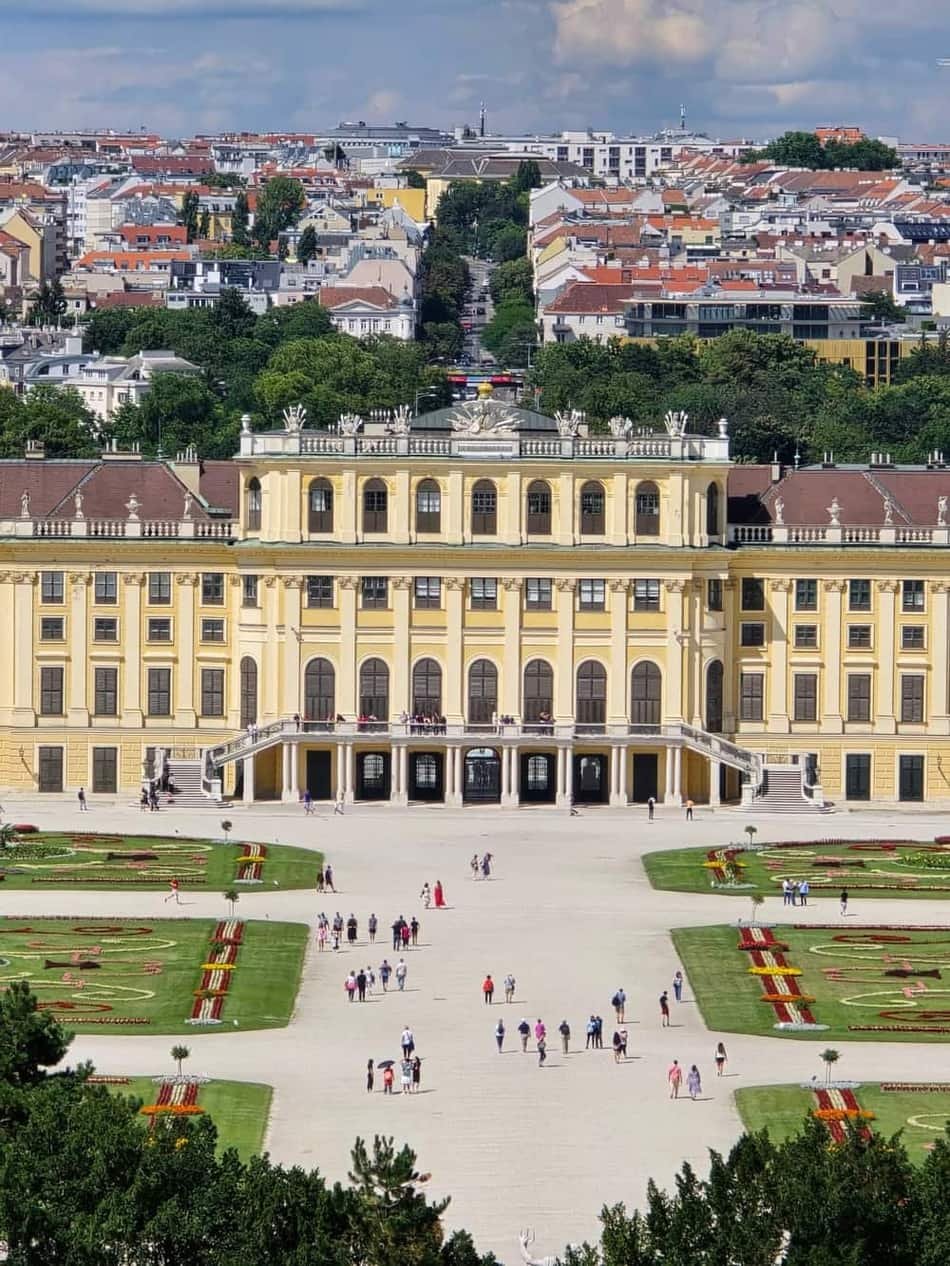
If you want to meet Maria Theresa in Vienna, go to Schönbrunn Palace. The former hunting lodge was rebuilt for her from the 1740s by Nikolaus Pacassi into the summer residence you see today, with Rococo state rooms such as the Great Gallery, the Chinese cabinets and the Millions Room. In 1752 her husband founded the menagerie that became the Schönbrunn Zoo, the oldest zoo still operating in the world. In her later years the gardens were given their crowning features: the Neptune Fountain and, on the hill, the Gloriette of 1775, designed by Johann Ferdinand Hetzendorf von Hohenberg as a monument to the "just war". The Palace Ticket covers her apartments; our Schönbrunn tickets guide explains the options.
Joseph II: the revolutionary emperor
When Francis Stephen died suddenly in 1765, Maria Theresa wore mourning for the rest of her life and made her son Joseph co-regent. Mother and son quarrelled for fifteen years: she was cautious and devout, he was impatient, rational and convinced that a well-run state should serve the "general good". He travelled incognito as "Count Falkenstein", visited hospitals, prisons and peasants' villages, and read Enlightenment writers. Even as co-regent he left marks on Vienna: in 1766 he opened the imperial hunting ground of the Prater to the public, and in 1775 the Augarten, whose gate still bears his dedication to all people from their admirer.
After his mother's death in November 1780 he governed alone, and the decrees came in a flood — by some counts, thousands in ten years.
- Toleration. The Patent of Toleration of 1781 gave Protestants and Orthodox Christians the right to worship privately, build churches without towers or street entrances and hold public office. In 1782 a Tolerance Edict for the Jews of Lower Austria lifted many humiliating restrictions, while keeping others and aiming at assimilation.
- Serfdom. Personal serfdom was abolished in the Bohemian lands in 1781 and later elsewhere, freeing peasants to marry, move and learn a trade.
- The Church. Around 700 contemplative monasteries were dissolved, their wealth used for parishes, schools and welfare. Pope Pius VI travelled to Vienna in 1782 to change the emperor's mind, and failed.
- Censorship was relaxed and a lively pamphlet culture blossomed in Vienna's coffee houses.
- The Burgtheater was declared a German national theatre in 1776, and Joseph encouraged German-language opera. He commissioned Mozart's *The Abduction from the Seraglio* (1782) and allowed *The Marriage of Figaro* (1786), based on a banned play, to reach the stage. The story that he told Mozart there were "too many notes" is famous and poorly sourced.
Medicine, madness and death: Joseph's Vienna
Joseph's most lasting monument is medical. In 1784 he opened the General Hospital (Allgemeines Krankenhaus) in Alsergrund, one of the largest in Europe, with a separate round tower for the mentally ill, the Narrenturm, now home to a pathological-anatomical collection. In 1785 came the Josephinum, a military medical academy, whose Florentine anatomical wax models you can still see at the Josephinum.
He also regulated death. For hygiene, burials inside the city were banned and new cemeteries opened beyond the outer defensive line, among them the St. Marx Cemetery, where Mozart was buried in 1791. His order that the dead be buried in sacks and a reusable "economy coffin" with a trapdoor provoked such outrage that he withdrew it within months — a fair summary of his reign.
Failure and legacy
Joseph moved too fast for everyone. The nobility resented losing their peasants, the clergy their monasteries, the Hungarians their language after he made German the language of administration in 1784. In Transylvania, the peasant uprising led by Horea, Cloșca and Crișan in 1784 was crushed with great brutality; Horea had travelled to Vienna to petition the emperor, and the revolt helped push Joseph to abolish serfdom in Hungary and Transylvania the following year. The Austrian Netherlands rose in revolt in 1789, and an unsuccessful war against the Ottomans ruined his health. Dying in February 1790, he revoked most of his reforms for Hungary. He is said to have proposed his own epitaph — here lies a ruler who failed in everything he attempted — though, like many Joseph stories, it is better told than documented.
Yet the core survived: toleration, the abolition of personal serfdom, state schools, the hospital, a professional civil service. Nineteenth-century liberals made Joseph their hero, and the equestrian Joseph II Monument by Franz Anton Zauner stands at the centre of Josefsplatz, beside the Baroque State Hall of the National Library.
Where to find them in Vienna today
- The Imperial Crypt. In the Capuchin Crypt, Maria Theresa and Francis Stephen lie in a vast double sarcophagus by Balthasar Ferdinand Moll, half-rising to face each other as if waking on Judgement Day. At its foot stands Joseph's plain copper coffin — the emperor who wanted simplicity even here.
- Maria-Theresien-Platz. Between the two great museums sits the Maria Theresa monument by Kaspar von Zumbusch (1888), surrounded by her generals, ministers, van Swieten and even the young Mozart. It is on our Ringstrasse walk.
- The Albertina. Her favourite daughter Maria Christina and her husband Albert of Saxe-Teschen founded the collection of the Albertina; Canova's pyramid tomb of Maria Christina is in the Augustinian Church.
- Schönbrunn and the Hofburg. See our palaces page for tickets and timings, and the Hietzing district for the neighbourhood around the palace.
If you are travelling from Romania, the story has an extra layer: the Landler deportations, Joseph's journeys through Transylvania and the 1784 uprising connect Vienna directly to Transylvanian history. Our from Romania page has the practical side of the trip.
Where to stay nearby
Live prices and availability on a map centred on this exact spot — hotels, apartments and hostels, so you can judge the walk from here rather than guess from an address.
Bookings made through this map earn us a commission. Your price is unaffected.