The city
Empress Sisi: The Woman Behind the Myth
Tony Denesa – Travel Advisor10 min read
The short version
Elisabeth of Austria (1837–1898), known in the family as Sisi, was empress for 44 years and spent a good part of them avoiding Vienna. She was a gifted rider, an obsessive dieter and walker, a poet who admired Heine, a champion of Hungary and, in the end, the victim of an anarchist who had wanted to kill someone royal and found her on a Geneva quay. The pink, smiling "Sissi" of the cinema was invented half a century after her death. The real woman is far more interesting, and Vienna lets you follow her closely.
A Bavarian girl, a sudden engagement
Elisabeth was born in Munich on 24 December 1837, a Duchess in Bavaria of the House of Wittelsbach, and grew up largely at Possenhofen on Lake Starnberg, with a father who preferred circuses and country life to court. In August 1853 her mother took her along to Bad Ischl, where her elder sister Helene was expected to become engaged to the young emperor Franz Joseph, their cousin. He chose the fifteen-year-old Sisi instead.
They married on 24 April 1854 in the Augustinian Church, the court's parish church in the Hofburg. She was sixteen. The glamour ended quickly. Court protocol in Vienna was among the most rigid in Europe, and her aunt and mother-in-law, Archduchess Sophie, took control of the household and, soon, of the children.
Children, loss and flight
Four children were born: Sophie (1855), Gisela (1856), Rudolf (1858) and Marie Valerie (1868). Little Sophie died in 1857, aged two, during a journey to Hungary with her parents — a blow Elisabeth never truly recovered from. Rudolf and Gisela were raised largely by Sophie's appointees; Elisabeth fought, and eventually won, the right to decide on Rudolf's education.
From 1860 a pattern set in: illness, then long journeys. She went to Madeira, then Corfu, and for the rest of her life spent more time travelling than in Vienna. Some of it was genuine ill health, some depression, some a deliberate escape from a role she found suffocating.
Queen of Hungary
Elisabeth learned Hungarian, surrounded herself with Hungarian ladies-in-waiting and befriended liberal politicians, notably Count Gyula Andrássy. She was a sincere advocate of reconciliation, and after the Compromise of 1867 she and Franz Joseph were crowned King and Queen of Hungary in Buda on 8 June 1867. Her youngest daughter, Marie Valerie, was born in Buda the following year, and the palace of Gödöllő near Budapest became one of the few places she was happy. Hungarians loved her for it; many Viennese resented it.
The cult of beauty
The legend of Sisi's beauty is true, and it was work. She was around 172 cm tall and kept her weight near 50 kg for decades through severe diets and hours of exercise. Her ankle-length chestnut hair took hours to dress each day. She installed gymnastic rings and bars in her apartments — you can still see them in the Hofburg — and walked for hours at a pace her ladies-in-waiting dreaded. After her thirties she refused to be photographed or painted from life; the image the world knows is essentially fixed at around thirty. In public she hid behind fans, parasols and veils.
She was also one of the finest horsewomen of her age, hunting in England and Ireland in the 1870s. The court's famous horses are still on show at the Spanish Riding School.
Mayerling and the black years
On 30 January 1889 Crown Prince Rudolf, her only son, was found dead with the young Baroness Mary Vetsera at the hunting lodge of Mayerling in the Vienna Woods — a murder-suicide. Elisabeth wore black for the rest of her life. She travelled even more restlessly, and on Corfu built the Achilleion, a villa dedicated to her hero Achilles.
Franz Joseph, who seems to have loved her steadily despite everything, had already given her a retreat near Vienna: the Hermesvilla, built by Carl von Hasenauer between 1882 and 1886 in the former imperial hunting ground of Lainzer Tiergarten. She named it after a statue of Hermes and used it far less than he hoped. Today it belongs to the Wien Museum and makes a lovely walk in Hietzing.
Geneva, 10 September 1898
On 10 September 1898, walking to a lake steamer in Geneva, Elisabeth was stabbed in the chest by the Italian anarchist Luigi Lucheni with a sharpened file. The wound was so narrow she walked on and boarded the boat before collapsing; she died about an hour later, aged sixty. Lucheni had come to Geneva to kill a different royal and changed targets when he read in the newspaper that the empress was in town. She lies in the Imperial Crypt beside Franz Joseph and Rudolf.
Myth versus reality
- "Sissi" is a film name. The family wrote Sisi. The double-s spelling spread with Ernst Marischka's three films starring Romy Schneider (1955–1957), which ended long before the tragedies and made her a sugar-coated icon. Schneider spent years trying to escape the role.
- She was not a quiet victim. She was stubborn, often self-absorbed, sometimes cruel to those around her, and more politically effective over Hungary than the legend of a fragile beauty allows.
- She was not beloved in Vienna in her lifetime. The Viennese saw an absent empress. The cult grew after her murder and was industrialised by tourism in the twentieth century.
- The beauty regime was not glamour. Modern biographers read her diets and compulsive exercise as signs of an eating disorder.
- Recent screen versions, from Netflix's The Empress (2022) to Marie Kreutzer's Corsage (2022) with Vicky Krieps, have tried, with mixed accuracy, to show the restless woman instead.
Following Sisi in Vienna today
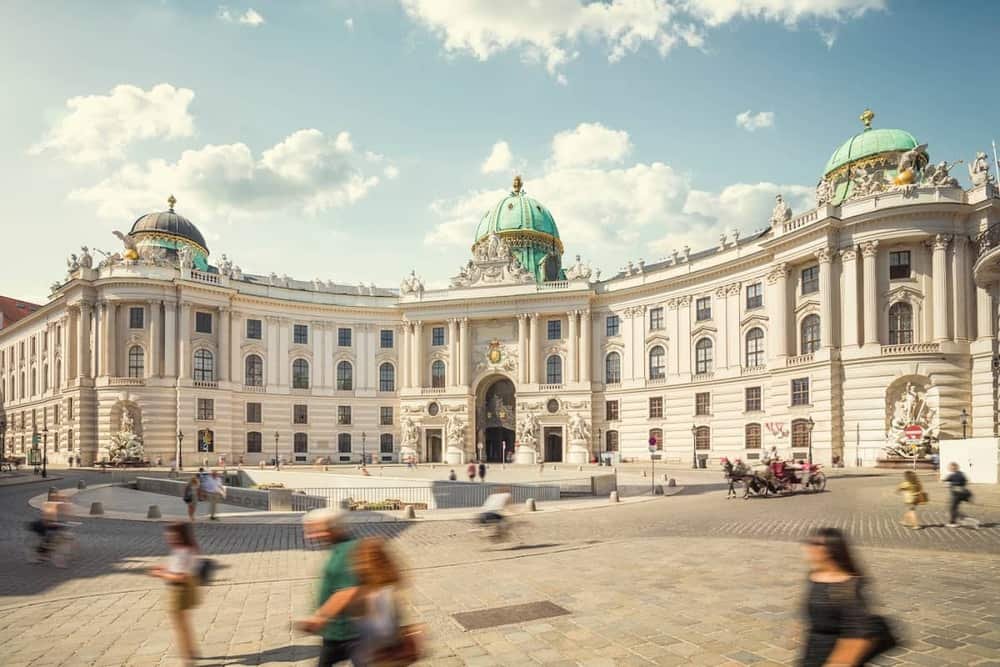
- Sisi Museum, Hofburg — the best starting point, in the Imperial Apartments wing. It deliberately separates myth from biography: dresses (some reconstructions), her travelling pharmacy, poems, and the story of her death. The ticket includes the Imperial Apartments, where you see her dressing and exercise rooms. See Hofburg & Sisi Museum tickets.
- Schönbrunn Palace — the summer residence where the couple had adjoining apartments. Combine with a walk up to the Gloriette.
- Furniture Museum — the imperial furniture depot, with rooms devoted to Elisabeth and far fewer crowds. Schönbrunn, the Sisi Museum and this museum are sold together as the Sisi Pass.
- Volksgarten — the white marble Empress Elisabeth Memorial, unveiled in 1907, sits in a quiet corner behind the rose beds.
- Augustinian Church — where she married, and where the Habsburg hearts are kept.
- Hermesvilla — her villa in the woods, best on a spring or autumn afternoon.
- Demel — the former court confectioner on Kohlmarkt still sells candied violets, a sweet long associated with her.
Everything above except the Hermesvilla sits in or near Innere Stadt or Schönbrunn. For the dynasty's wider story read Habsburg Vienna; for every imperial residence, see palaces.
An honest tip
The Sisi industry is everywhere: chocolates, mugs, dirndl-clad mannequins. The Sisi Museum is worth it precisely because it resists that. Book a timed slot, go early, and give the rooms an hour rather than rushing through to the gift shop.
Where to stay nearby
Live prices and availability on a map centred on this exact spot — hotels, apartments and hostels, so you can judge the walk from here rather than guess from an address.
Bookings made through this map earn us a commission. Your price is unaffected.