The city
The Viennese Coffee House: A History from 1683 Legend to UNESCO
Tony Denesa – Travel Advisor10 min read
The short version
Vienna did not invent coffee or the coffee house, but it invented a particular way of spending time: a marble-topped table, a bentwood chair, a glass of water, a rack of newspapers and a waiter who will not hurry you. The city's first coffee licence dates from 1685, not from the siege of 1683. The institution matured in the nineteenth century, became the office of the writers, artists and revolutionaries of Vienna 1900, nearly died in the age of the espresso bar, and in 2011 was entered in Austria's national inventory of intangible cultural heritage, under the UNESCO convention. That listing is national, not the international UNESCO list — a distinction Vienna's marketing sometimes blurs.
The legend: Kolschitzky's beans
Every Viennese knows the story. In 1683, during the Ottoman siege, Georg Franz Kolschitzky slipped through enemy lines as a courier. After the victory he asked for the sacks of strange beans left in the Ottoman camp, learned to brew them, and opened the city's first coffee house, adding milk and sugar to suit Viennese taste. A street in Wieden and a statue carry his name.
The courier mission is documented. The coffee house is not. The legend was promoted in the nineteenth century, not least by the coffee-house owners' guild, which liked a patriotic founding hero. For the military history, read The Siege of Vienna, 1683.
The record: an Armenian licence
The first documented privilege to serve coffee in Vienna was granted in 1685 to Johannes Diodato, an Armenian merchant and sometime diplomatic agent who had lived in the Ottoman world. Armenian and Greek traders dominated the early trade, and coffee was at first served alongside tea, chocolate and sherbet. Coffee houses already existed in Venice, Oxford, London and Paris; Vienna arrived late and made up for it.
Through the eighteenth century the number of licensed coffee brewers (*Kaffeesieder*) grew steadily. Coffee houses added billiards, cards and — crucially — newspapers, which ordinary customers could not afford to buy. The coffee house became a reading room, and it has never stopped being one.
The nineteenth century: the form takes shape
The Biedermeier years, after the Congress of Vienna, made the coffee house respectable and comfortable. Some establishments added music: the young Johann Strauss II made his debut in 1844 at Dommayer's casino in Hietzing, on the site of today's Café Dommayer. Café Frauenhuber, trading as a café since 1824, claims to be the oldest surviving coffee house; Mozart and Beethoven performed in the building when it housed an earlier restaurant.
The elements visitors now think of as timeless arrived in this century. Women were admitted as guests from 1856. In 1859 Michael Thonet's bentwood chair No. 14, light, cheap and nearly indestructible, became the standard café chair. Marble-topped tables, velvet banquettes, alcoves, the newspaper table and the formal waiter in black — the *Herr Ober* — completed the picture.
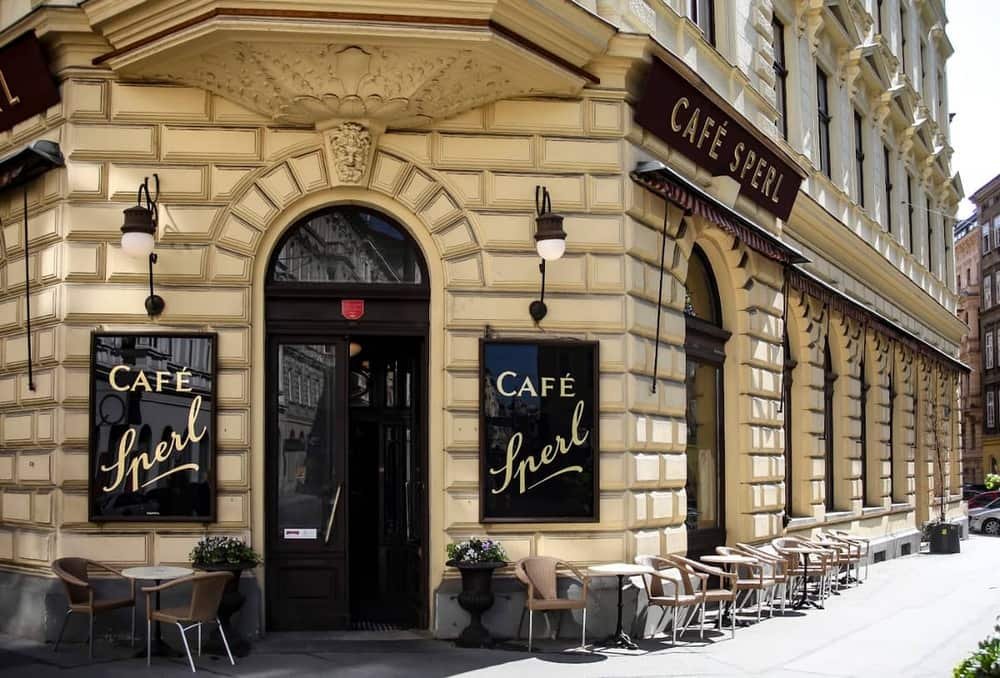
The Ringstrasse era produced the grand cafés. Café Schwarzenberg opened in 1861 and calls itself the oldest café on the Ring. Café Landtmann followed in 1873 beside the Burgtheater, Café Central in 1876 in the arcaded Palais Ferstel, and Café Sperl in 1880 near the Theater an der Wien, still with its billiard tables. Alongside them stood the court confectioners, whose business was cake rather than newspapers: Demel, dating to 1786, and Gerstner, from 1847. The rivalry over the most famous chocolate cake is in the Sachertorte story.
Around 1900: the office of genius
By the turn of the century the coffee house was where Vienna's intellectual life actually happened. Flats were cramped and cold; the café was warm, lit, supplied with dozens of papers and indifferent to how long you stayed. Writers took their mail there. Café Griensteidl, nicknamed "Café Megalomania", was the literary headquarters until the building was demolished in 1897; its regulars moved on to Café Central, where the poet Peter Altenberg was so permanent a fixture that a papier-mâché figure of him now sits by the door. Émigrés from across Europe read and played chess there before 1914, including a Russian revolutionary then calling himself Bronstein, better known as Trotsky. Adolf Loos designed the pared-back interior of Café Museum in 1899, and Café Prückel, opened in 1903, still has its 1950s interior facing the Stadtpark. The essayist Alfred Polgar famously described the Central as a place for people who want to be alone but need company to do it. More on this generation in Vienna 1900.
War, exile and the Hawelka years
The world wars, and above all the expulsion and murder of Vienna's Jews after 1938, destroyed much of the café public. Café Hawelka, opened by Leopold and Josefine Hawelka in 1939, reopened after the war and became the meeting place of a new generation of artists and writers; Josefine's warm yeast buns, the Buchteln, became legendary. Café Bräunerhof, the favourite of novelist Thomas Bernhard, reopened in June 2026 under new management.
From the 1950s to the 1970s, television, espresso bars, cars and suburban living emptied the old cafés. Many closed or became banks and car showrooms. The survivors lived on regulars, tourists and stubbornness.
Revival and recognition
The revival came gradually from the 1980s, helped by nostalgia, by tourism and by films such as *Before Sunrise* (1995), part of which was shot at Café Sperl. In 2011, "Viennese coffee house culture" was added to Austria's national inventory of intangible cultural heritage, compiled under the 2003 UNESCO convention. The entry describes the marble tables, Thonet chairs, alcoves and newspaper tables, and the coffee house as a place where time and space are consumed but only the coffee appears on the bill. It is a genuine honour, but it is not the international UNESCO Representative List, and it is certainly not UNESCO World Heritage.
The coffee house in 2026
- Café Central — in its 150th anniversary year, it has been closed for renovation since 16 March 2026, with reopening announced for winter 2026. A temporary pop-up operates nearby at Freyung 3.
- The classics that are open: Sperl, Landtmann, Prückel, Hawelka, Schwarzenberg, Frauenhuber, Museum and Bräunerhof, most in Innere Stadt, Sperl in Mariahilf.
- The court confectioners: Demel on Kohlmarkt, Gerstner on Kärntner Strasse, and Café Sacher behind the Opera.
- The new wave: specialty roasters such as Jonas Reindl serve very different coffee in very different rooms; Vollpension, where retirees bake the cakes, is a modern twist on the old living-room idea.
Browse every address on our coffee houses hub.
How to use a coffee house like a local
Sit where you like unless a sign says otherwise. Order a Melange (roughly a cappuccino), a kleiner Brauner (espresso with a little milk) or an Einspänner (black coffee in a glass with whipped cream). A glass of water arrives with it, and refills come without asking. Nobody will bring the bill until you ask. Newspapers are for everyone; put them back on the rack. The full code is in coffee-house etiquette, and the vocabulary in the Viennese German primer.
An honest note
The most famous cafés now have queues at the door, and a queue is the opposite of what a coffee house is for. Go at opening time or in mid-afternoon on a weekday, or choose a neighbourhood café where the waiter recognises the regulars. Service can be brusque; that too is tradition, not personal. The point is not the coffee — which can be ordinary — but the permission to stay.
Where to stay nearby
Live prices and availability on a map centred on this exact spot — hotels, apartments and hostels, so you can judge the walk from here rather than guess from an address.
Bookings made through this map earn us a commission. Your price is unaffected.