Guides
Viennese Coffee House Etiquette: How to Order, Sit and Pay Like a Local
Tony Denesa – Travel Advisor9 min read
The short version
A Viennese coffee house is not a place to grab a coffee. It is a place to spend time — to read the papers, write, argue, meet, or simply watch the room — for the price of a single cup. Viennese coffee house culture was added to Austria's national inventory of Intangible Cultural Heritage, under the UNESCO convention, in 2011; the entry cites the marble-topped tables, Thonet chairs, alcoves and newspaper tables as its hallmarks.
The essentials, before we go into detail:
- Walk in and look around. In most classic cafés you choose your own free table; in the famous, busy ones a waiter will seat you.
- Order by name. "A coffee" means nothing here — ask for a Melange, a Brauner or an Einspänner.
- Stay as long as you like. Nobody will rush you after one cup.
- Call the waiter "Herr Ober" and pay at the table: say "Zahlen, bitte".
- Round up or add 5–10% by stating the total when you pay.
A note for autumn 2026: Café Central is closed for renovation — since 16 March 2026, reopening planned for winter 2026, with a pop-up called DECENTRAL at Freyung 3 in the meantime (cafecentral.wien, checked September 2026). Everything below works just as well at the dozens of classic houses that are open; our coffee houses page lists them all.
Arriving and choosing a table
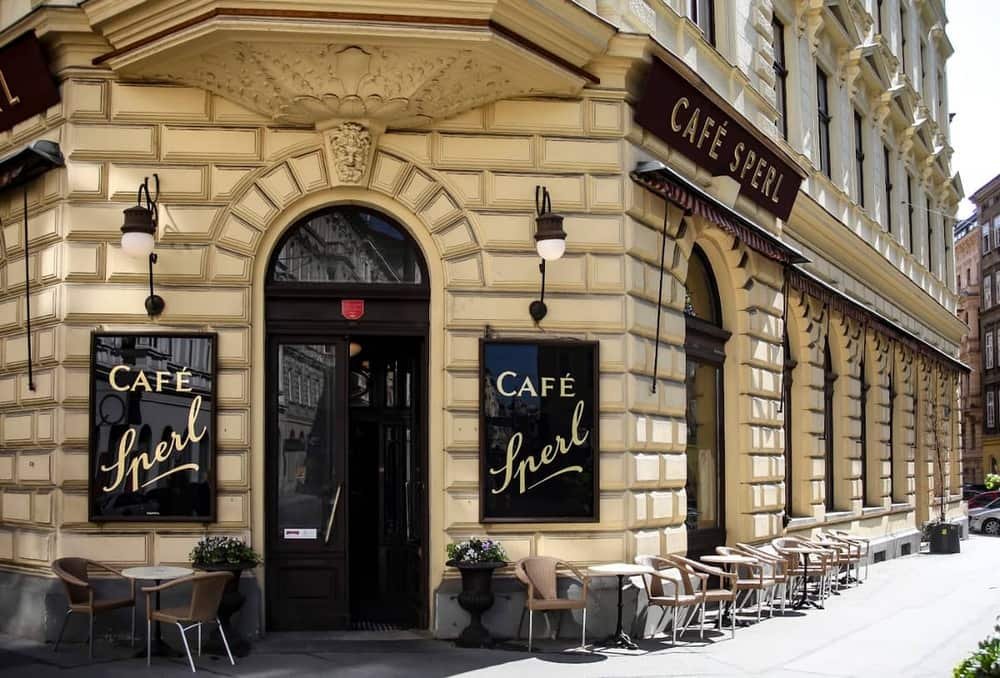
The first rule is not to stand at the door waiting politely for too long. In a traditional neighbourhood café such as Café Sperl in Mariahilf, with its billiard tables and 1880 interior, you look for a free table, take off your coat — there is often a coat stand — and sit down. A waiter will come, sometimes after a pause that is part of the style.
In the landmark houses on every visitor's list — Café Sacher, Demel, Café Landtmann at busy times — there may be a queue and a host. Wait your turn there.
Sharing a table with strangers is not usual unless the café is full and you ask first. A marble table for two, a newspaper and a window seat is the ideal.
What to order
Coffee comes with a glass of water, traditionally refilled without asking. The classic list, roughly from strongest to mildest:
- Kleiner Schwarzer / Mokka — a single espresso-style black coffee.
- Großer Schwarzer — a double.
- Kleiner / Großer Brauner — black coffee served with a little cream or milk on the side.
- Verlängerter — a lengthened black coffee with hot water, the Viennese answer to a filter coffee.
- Wiener Melange — the house favourite: coffee with steamed milk and milk foam. Softer than a cappuccino.
- Einspänner — a strong black coffee in a glass under a crown of whipped cream. Do not stir it; drink the coffee through the cream.
- Kapuziner — black coffee with a dash of cream, the colour of a Capuchin's habit.
- Franziskaner — a Melange topped with whipped cream instead of foam.
- Fiaker — a coffee with a shot of rum or brandy, named after the horse-drawn carriages.
If you just want milk coffee, a Melange is always a safe order. Ask for "Schlagobers" if you want whipped cream on the side.
Cake, and the rest of the menu
Coffee houses are also places to eat. Most serve breakfast, simple warm dishes — goulash, sausages, a schnitzel at lunchtime — and a cake display that deserves a slow look. The classics:
- Sachertorte — chocolate cake with apricot jam, the signature of Café Sacher; the rivalry with Demel is a story of its own, told in the Sachertorte story.
- Apfelstrudel and Topfenstrudel (with sweet curd cheese), often served warm.
- Esterházy torte — almond meringue layers with a feathered white icing.
- Buchteln — yeast buns filled with jam, the speciality of Café Hawelka, founded in 1939 by Leopold and Josefine Hawelka.
In a traditional café you usually point to the cake at the vitrine or ask the waiter; in a Konditorei such as Demel, the former court confectioner founded in 1786, you often choose at the counter and your order is brought to the table. For more dishes, see what to eat in Vienna.
How long can you stay?
As long as you want, within reason. This is the heart of the tradition: the coffee house as a public living room where one coffee buys a seat for the afternoon. Nobody will bring the bill unasked. The only exceptions are the handful of famous cafés with queues outside at peak hours, where lingering for two hours over a Melange while people wait is poor form. In a neighbourhood café on a rainy Tuesday, bring a book.
Newspapers — Austrian dailies and often some international titles — hang on wooden holders. Take one, read it at your table and return it to the rack.
Talking to the waiter
The waiters of Vienna's coffee houses are famous, and famously brusque. Traditionally dressed in black and white, they are addressed as "Herr Ober". Their manner — correct, dry, occasionally theatrical — is not rudeness but style, what locals call *Schmäh*. A friendly "Grüß Gott" on arrival and patience go a long way.
Raising a hand briefly or catching the waiter's eye is enough to get attention. Waving, whistling or calling across the room is not done.
Paying and tipping
When you are ready, say "Zahlen, bitte" ("the bill, please"). Your waiter settles at the table, usually with a leather wallet and a card terminal. The Vienna Tourist Board advises a tip of 5–10% depending on satisfaction (wien.info, checked September 2026). The local way is to state the total you want to pay as you hand over the money or card — if the bill is 17.40, say "20" or "19" — rather than leaving coins on the table afterwards.
Where to practise
A few classic houses, with hours as published in September 2026 on their own websites:
- Café Landtmann (1873), on the Ring by the Burgtheater — elegant, political, busy at lunch. Mon–Sat 07:30–24:00, Sun to 22:00.
- Café Sperl (1880) — the least changed, and the most film-set-like. Closed on Sundays in July and August.
- Café Prückel (1903), facing the Stadtpark — 1950s interior, card players, locals. Daily 08:30–22:00.
- Café Museum (1899), near the Opera, with an interior originally by Adolf Loos.
- Café Schwarzenberg (1861), the oldest café on the Ringstrasse.
- Café Frauenhuber (1824), which claims to be the oldest coffee house in the city.
- Café Bräunerhof, Thomas Bernhard's café, reopened in June 2026 under new management.
And when it reopens, Café Central, which celebrates its 150th anniversary in 2026.
Mistakes to avoid
- Asking for coffee to go. Classic coffee houses are not takeaway counters; specialty coffee bars are.
- Calling a Melange a cappuccino. It is close, but the waiter will notice.
- Stirring an Einspänner.
- Paying at the counter. You pay your waiter at the table.
For the history behind all this — the legends of 1683, the literary cafés of 1900 — read the Viennese coffee house history, and fit a slow afternoon into your three days in Vienna.
Where to stay nearby
Live prices and availability on a map centred on this exact spot — hotels, apartments and hostels, so you can judge the walk from here rather than guess from an address.
Bookings made through this map earn us a commission. Your price is unaffected.