The city
Vienna 1900: Klimt, Freud, Mahler, Wagner and the Birth of the Modern
Tony Denesa – Travel Advisor11 min read
The short version
Between the late 1890s and the end of the First World War, Vienna produced an extraordinary concentration of people who shaped the twentieth century: Gustav Klimt and Egon Schiele in painting, Otto Wagner and Adolf Loos in architecture, Gustav Mahler and Arnold Schoenberg in music, Sigmund Freud in psychology, Ludwig Wittgenstein in philosophy, Karl Kraus and Arthur Schnitzler in letters. They knew each other, argued in the same coffee houses and often loathed each other's work. Historians call it "Vienna 1900" or fin-de-siècle Vienna. Unusually, almost all of it can still be seen within a few tram stops.
A capital in a hurry
The context matters. By 1900 Vienna had around 1.7 million inhabitants, drawn from every corner of the Habsburg empire. The new Ringstrasse had wrapped the old town in historicist pomp — neo-Gothic, neo-Renaissance, neo-Greek. A liberal, largely Jewish and German-speaking bourgeoisie financed the arts, while the city was governed from 1897 to 1910 by Karl Lueger, a populist mayor who modernised utilities and trams and used antisemitism as a political tool. The young Adolf Hitler, a failed art student, lived in Vienna from 1908 to 1913. Vienna 1900 was brilliant and poisonous at once, and the best museums no longer separate the two.
1897: the Secession
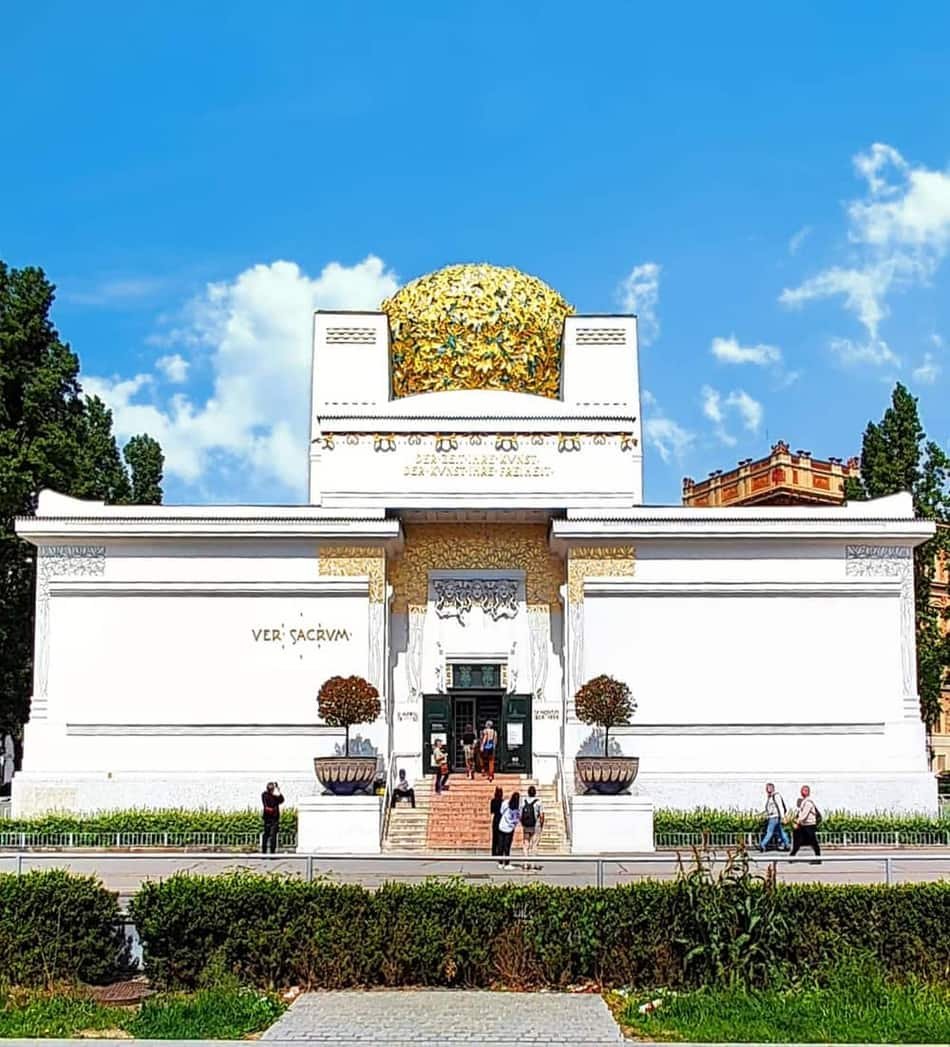
In 1897 a group of younger artists led by Klimt, with Koloman Moser, Josef Hoffmann and the architect Joseph Maria Olbrich, left the conservative artists' association to found the Vienna Secession. Olbrich designed their exhibition hall near Karlsplatz in 1897–98: a white cube topped by a dome of gilded laurel leaves that the Viennese promptly nicknamed "the golden cabbage". Above the door runs the motto coined by critic Ludwig Hevesi: to the age its art, to art its freedom.
The Secession still shows contemporary art. In the basement is Klimt's Beethoven Frieze, painted for the 1902 exhibition devoted to Beethoven and one of the key works of the period. It is a short walk from the Wien River valley and the markets of Mariahilf.
Klimt and Schiele
Gustav Klimt (1862–1918) began as a successful decorator of Ringstrasse interiors — his early paintings still hang above the grand staircase of the Kunsthistorisches Museum. His turn came with the University ceiling paintings, *Philosophy*, *Medicine* and *Jurisprudence*, attacked as obscene around 1900; he withdrew them, and they were destroyed by fire in 1945. The "golden period" followed, culminating in The Kiss (1907–08), which the state bought almost immediately and which hangs in the Upper Belvedere — see Belvedere & Klimt tickets. Klimt is buried in the Hietzing Cemetery, not far from Otto Wagner and Koloman Moser.
Egon Schiele (1890–1918), Klimt's protégé, pushed the body into raw, angular, often shocking self-exposure. He was briefly jailed in 1912. He died of Spanish flu on 31 October 1918, three days after his pregnant wife and months after Klimt, aged twenty-eight. The largest collection of his work is at the Leopold Museum in the MuseumsQuartier, alongside major Klimt and Kokoschka holdings.
Otto Wagner and Adolf Loos
Otto Wagner (1841–1918) was already a Ringstrasse architect in his fifties when he declared that modern life needed modern forms. As chief architect of the Stadtbahn, the city railway, he designed stations, bridges and the elegant green-and-gold Karlsplatz pavilions of 1898–99. On the Linke Wienzeile, his Majolikahaus wears a façade of weatherproof flowered tiles. His masterpieces are the Postal Savings Bank (1904–06, extended 1910–12), with aluminium bolts and a glass-roofed banking hall, and the golden-domed Church am Steinhof (1904–07), built for a psychiatric hospital in Penzing. Opening hours at Steinhof are limited, so check before going. His first villa in Hütteldorf is now a private museum.
Adolf Loos (1870–1933) thought the Secession's ornament was a betrayal. His essay-lecture Ornament and Crime (1910) argued that decoration was wasted labour. His building on Michaelerplatz, facing the Hofburg (1909–11), scandalised the court with its plain upper façade — the "house without eyebrows". His tiny Loos American Bar of 1908 remains one of the most perfect small rooms in Europe, and he designed the spare interior of Café Museum in 1899, nicknamed "Café Nihilismus".
In 1903 Hoffmann and Moser founded the Wiener Werkstätte, applying the same ideals to furniture, silver, glass and fashion. The Museum of Applied Arts (MAK) holds the finest collection.
Freud, Mahler, Schoenberg, Wittgenstein
Sigmund Freud lived and worked at Berggasse 19 in Alsergrund from 1891 until he fled to London in 1938. *The Interpretation of Dreams* appeared in November 1899, dated 1900. The apartment is now the Sigmund Freud Museum; the famous couch went with him to London.
Gustav Mahler directed the Court Opera — today's State Opera — from 1897 to 1907, modernising staging with the designer Alfred Roller and enforcing discipline the orchestra resented. He married Alma Schindler in 1902, died in Vienna in 1911 and is buried in Grinzing. Arnold Schoenberg broke with tonality; the 1913 "Scandal Concert" at the Musikverein ended in a brawl. With his pupils Alban Berg and Anton Webern he formed the Second Viennese School — more in music in Vienna.
Ludwig Wittgenstein, born in 1889 into one of the richest families in the empire, wrote the *Tractatus* after the war. The satirist Karl Kraus attacked everyone in his magazine *Die Fackel* from 1899. Theodor Herzl, a Viennese journalist, published *The Jewish State* in 1896.
Where they argued
The coffee house was the office. Writers moved from Café Griensteidl, demolished in 1897, to Café Central, where the poet Peter Altenberg took his mail. Café Central is closed for renovation in 2026, with reopening announced for winter 2026. For the atmosphere, try Café Museum or Café Sperl. See the history of the Viennese coffee house.
Seeing Vienna 1900 in a day or two
- Karlsplatz circle (half a day): Secession, Wagner Pavilions, Majolikahaus and the Wien Museum Karlsplatz, whose free permanent exhibition includes Klimt's portrait of Emilie Flöge and a reconstruction of Loos's own living room. All in Wieden and Mariahilf.
- Painting (half a day): Leopold Museum for Schiele, Upper Belvedere for Klimt.
- Innere Stadt: Postal Savings Bank, Loos's Michaelerplatz building, the Loos Bar, then the MAK.
- Further out: Steinhof, Freud's Berggasse, the Hietzing Cemetery.
Our Jugendstil walk links most of these on foot, and the museums guide helps choose.
An honest note
"Vienna 1900" is now a brand, printed on scarves and umbrellas. The real period was short, contentious and ended in catastrophe: Klimt, Wagner, Schiele and Moser all died in 1918, the empire fell the same year, and many of the families who had paid for this art were driven out or murdered after 1938. Several of the most famous Klimts left Austria only after long restitution battles. Look at the gold, but remember who is missing — Jewish Vienna tells that part.
Where to stay nearby
Live prices and availability on a map centred on this exact spot — hotels, apartments and hostels, so you can judge the walk from here rather than guess from an address.
Bookings made through this map earn us a commission. Your price is unaffected.