Blog
Vienna 1900: A Jugendstil Walk from the Secession to Loos
Tony Denesa – Travel Advisor12 min read
The short version
Around 1900 a handful of architects and artists turned Vienna, the capital of historicist pomp, into one of the birthplaces of modern design. This walk links their key buildings in the centre in roughly four to five kilometres: the Secession, Otto Wagner's houses on the Linke Wienzeile and his Stadtbahn pavilions at Karlsplatz, Adolf Loos's Café Museum, American Bar and the scandalous house on Michaelerplatz, and finally Wagner's Postal Savings Bank. Allow three hours at a stroll, a full day if you go inside the museums. For the wider story of Klimt, Freud, Mahler and Schiele, read Vienna 1900; for the historicist city they rebelled against, The Ringstrasse.
Best days: Wednesday to Saturday. The Secession is closed on Mondays, the Leopold Museum on Tuesdays, and the Naschmarkt stalls on Sundays (all as published on the official sites, checked September 2026).
Jugendstil, Secession style — what are we looking at?
*Jugendstil* is the German-speaking cousin of Art Nouveau. In Vienna it took a particular form, often called Secession style: flatter, more geometric and more disciplined than the whiplash curves of Paris or Brussels. Squares, grids, gold leaf, stylised laurel and tiles that could be washed clean. It grew out of a revolt. In 1897 a group of younger artists led by Gustav Klimt walked out of the conservative Künstlerhaus and founded the Vienna Secession. Otto Wagner, already in his late fifties and the city's most successful architect, joined them in 1899 — a rare case of the establishment switching sides.
Stop 1: the Secession
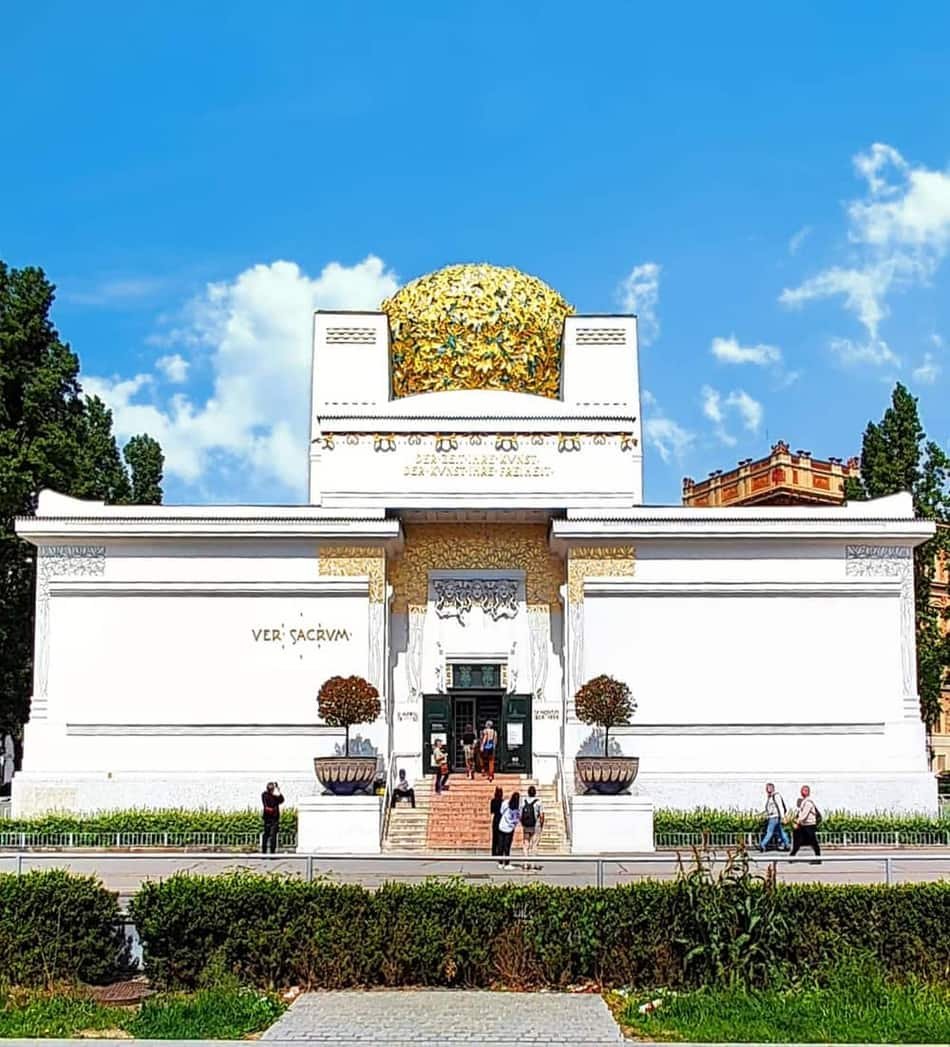
Start at the Secession on Friedrichstrasse, designed by Joseph Maria Olbrich and completed in 1898 as the group's exhibition hall. Above the entrance runs its creed: *Der Zeit ihre Kunst, der Kunst ihre Freiheit* — to every age its art, to art its freedom. The dome of gilded wrought-iron laurel leaves earned it the Viennese nickname "the golden cabbage". In the basement is Klimt's Beethoven Frieze, painted for the 1902 exhibition devoted to Beethoven and meant to be temporary. It was removed, sold, bought by the Austrian state in 1973 and, after long restoration, has been on show again since 1986. It is the one work on this walk you should not skip. The Secession offers free entry on the first Wednesday of the month (checked on secession.at, September 2026).
Stop 2: Naschmarkt and the Wagner houses
Walk south-west along the Naschmarkt, Vienna's long market that sits on top of the vaulted-over Wien river. At its far end, on the right-hand side of the Linke Wienzeile, stand two apartment buildings by Otto Wagner from 1898–1899. No. 40, the Majolikahaus, is covered in weatherproof ceramic tiles printed with a pink and green flowering vine that seems to grow up the façade. No. 38, on the corner, is decorated with gilded medallions and figures by Koloman Moser. Both are private homes: admire them from the pavement, ideally from the market side of the street, where you can see the whole composition. If you need coffee, Drechsler Wienzeile is near the Karlsplatz end of the market.
Stop 3: the Karlsplatz pavilions
Walk back to Karlsplatz. Between 1894 and 1901 Wagner designed the entire Stadtbahn, Vienna's steam-then-electric city railway: bridges, viaducts, lamps, railings and around thirty stations. The two facing pavilions of the Karlsplatz station are the showpieces — steel frames filled with white marble slabs, green ironwork and gilded sunflowers. When the U-Bahn was built in the 1970s they were dismantled and re-erected on new foundations. One houses a small Wien Museum display on Wagner, usually open in the warmer months; check before going.
Across the square, the Wien Museum — free for its permanent exhibition, as listed on the city's official page — holds Klimt's portrait of Emilie Flöge and a reconstruction of Adolf Loos's own living room. And behind it, the Baroque Karlskirche reminds you what Wagner was quoting and what he was leaving behind.
Stop 4: Café Museum — Loos's opening shot
A few steps north on Operngasse, Café Museum opened in 1899 with an interior by the 29-year-old Adolf Loos: bentwood chairs, plain surfaces, brass and no ornament at all, which is why the Viennese nicknamed it "Café Nihilismus". Klimt and the writer Peter Altenberg were regulars. The interior has been altered and restored more than once since, so treat it as an homage rather than a time capsule — but it is a good place to sit and understand the argument. Loos and the Secessionists were allies against historicism and enemies about almost everything else. He thought their gold leaf was just another costume.
Stop 5: the Loos American Bar
Walk past the Opera and up Kärntner Strasse. In a narrow passage on the left, the Kärntner Durchgang, is the Loos American Bar of 1908: a room barely bigger than a hotel bathroom, lined with mahogany, onyx and a coffered marble ceiling, with mirrors set above the panelling so the space seems to go on forever. It opens in the evening, so either return later for a cocktail or look through the door on your way past. It is the best lesson on this walk in how Loos used expensive materials instead of ornament.
Stop 6: Graben — insurance, tailoring and a Slovenian genius
At Stephansplatz, detour to the Zacherlhaus on the Brandstätte (1903–1905), by Wagner's most gifted pupil, the Slovenian Jože Plečnik: dark granite slabs, a row of Atlas figures under the cornice and a bronze archangel Michael at the corner. Then walk onto the Graben. At No. 10, Wagner's Ankerhaus (1894–1895) for the Anker insurance company shows him already moving towards glass and iron at street level. Nearby, the black granite portal of the Knize tailoring shop (Loos, 1910–1913) is still a working gentlemen's outfitter. If you are a clock lover, the Anker company also commissioned the Jugendstil Ankeruhr on Hoher Markt, a five-minute walk away, whose figures parade at noon.
Stop 7: the house "without eyebrows"
Kohlmarkt leads to Michaelerplatz and the building that caused the biggest architectural scandal in Vienna's history. The Looshaus (1909–1911), built for the tailors Goldman & Salatsch, faces the imperial Michaelertor of the Hofburg. Its lower floors are clad in green Cipollino marble with Tuscan columns; above, the façade is bare white render with plain windows. The Viennese called it the house without eyebrows. The city halted the works in 1910, and the compromise was bronze window boxes planted with flowers. The story that Franz Joseph avoided looking out of the windows facing it is told everywhere and impossible to verify. In 1910 Loos delivered his lecture *Ornament and Crime*, and this house is the argument in stone. Today it is a bank; the ground-floor hall is generally accessible during opening hours.
Stop 8: the Postal Savings Bank
To finish, walk east through the old town (about 20 minutes) to Georg-Coch-Platz and the Postal Savings Bank, Wagner's masterpiece of 1904–1906, extended 1910–1912. The façade is covered in thin marble plates fixed with aluminium-capped bolts, which Wagner used as decoration and honesty at once. Inside, the banking hall has a glass ceiling, a glass-block floor to light the basement and aluminium heating vents that look like sculpture. The building is now used largely by the University of Applied Arts, and access to the hall changes, so check before you go. Opposite, the Museum of Applied Arts (MAK) has one of the best collections of the Wiener Werkstätte, the design workshop founded in 1903 by Josef Hoffmann and Koloman Moser.
Beyond the centre: three more pilgrimages
- Kirche am Steinhof (1904–1907), Wagner's golden-domed church for a psychiatric hospital in Penzing, with windows by Moser. It opens only at limited times, managed by the Wien Museum — see the Steinhof church page and the Penzing district.
- Wagner's first villa (1886–1888) on Hüttelbergstrasse, now the Ernst Fuchs Museum.
- The paintings. Klimt's *The Kiss* hangs in the Upper Belvedere; the world's largest Schiele collection is at the Leopold Museum in the MuseumsQuartier.
Practical notes
Wear comfortable shoes: the walk is flat but long. Combine it with lunch at the Naschmarkt or in a coffee house, and with an evening at the Musikverein or the Opera, both of which you pass. Staying nearby? Our Wieden and Innere Stadt pages list hotels within walking distance of the start.
Where to stay nearby
Live prices and availability on a map centred on this exact spot — hotels, apartments and hostels, so you can judge the walk from here rather than guess from an address.
Bookings made through this map earn us a commission. Your price is unaffected.