The city
Music in Vienna: From Haydn and Mozart to Strauss and the Philharmonic
Tony Denesa – Travel Advisor11 min read
The short version
No other city can claim so much of the classical repertoire as home ground. Haydn, Mozart, Beethoven, Schubert, Brahms, Bruckner, the Strauss family, Mahler and Schoenberg all lived and worked here. The reasons were practical: an imperial court that paid for music, an aristocracy that competed through private orchestras, a middle class that bought pianos and sheet music, and a city of opera houses, dance halls and churches that needed new music every week. That ecosystem still exists. On a single evening you can hear the Vienna Philharmonic in the Golden Hall, opera at one of the world's busiest houses, a Mass in the imperial chapel on Sunday — and walk past the rooms where the music was written.
The court and the church
Music was a Habsburg instrument of power. In 1498 Maximilian I re-established the court chapel with its boy choristers, the ancestor of the Vienna Boys Choir, which still sings Sunday Mass at 09:15 in the Hofburg chapel from September to June. Several seventeenth-century emperors, above all Leopold I, composed themselves, and Italian opera became the court's favourite spectacle. In 1762 Christoph Willibald Gluck premiered *Orfeo ed Euridice* at the Burgtheater, the work that began his reform of opera. The dynasty's wider story is told in Habsburg Vienna.
Haydn and Mozart
Joseph Haydn spent most of his career in the service of the Esterházy princes but kept close ties with Vienna and settled in the suburb of Gumpendorf, where he died in 1809 during the French occupation. In 1797 he wrote the imperial hymn for Francis II; its melody later became the tune of the German national anthem.
Wolfgang Amadeus Mozart played for Maria Theresa at Schönbrunn as a six-year-old in 1762, and moved to Vienna for good in 1781 as a freelance musician — a risky career then. From 1784 to 1787 he lived in a large apartment behind St. Stephen's, now the Mozarthaus Vienna, where he wrote *The Marriage of Figaro*, premiered at the old Burgtheater in 1786. *The Magic Flute* opened on 30 September 1791 at Emanuel Schikaneder's suburban Theater auf der Wieden. Ten weeks later, on 5 December 1791, Mozart died, leaving the *Requiem* unfinished.
Two myths to drop. Mozart was not buried in a pauper's grave: he received a simple common grave of the kind prescribed for ordinary citizens under Joseph II's reforms, in the St. Marx Cemetery, where a memorial marks the approximate spot. And Antonio Salieri, the respected court composer who taught Beethoven, Schubert and Liszt, did not poison him — the story comes from rumour, a Pushkin play and the 1984 film *Amadeus*. Mozart's white marble statue stands in the Burggarten; see the Mozart Monument.
Beethoven
Ludwig van Beethoven arrived from Bonn in 1792 to study with Haydn and never left. Aristocratic patrons made his career: the Eroica was first played privately in 1804 at Palais Lobkowitz, now the Theatre Museum, and the Russian ambassador Count Razumovsky, whose palace still stands in Landstrasse, commissioned three string quartets. He moved house dozens of times. In the summer of 1802, in the village of Heiligenstadt, facing his growing deafness, he wrote the anguished letter known as the Heiligenstadt Testament; the house is now part of the Beethoven Museum in Döbling. In 1817 he spent the summer in a house that is now the Heuriger Mayer am Pfarrplatz.
His only opera, *Fidelio*, premiered in 1805 at the Theater an der Wien, which Schikaneder had opened in 1801 and which still presents opera today. The Ninth Symphony was first performed in 1824 at the Kärntnertortheater, on a site near today's Opera. He died in March 1827; some twenty thousand people are said to have followed the funeral.
Schubert and the Biedermeier salon
Franz Schubert was the only one of the great names born in Vienna, in 1797, in what is now Alsergrund. He never held a court post and rarely heard his larger works performed. His world was the Schubertiade: an evening of songs, piano duets and friends in private apartments. He died in 1828, aged thirty-one, in his brother's flat in Wieden, and asked to be buried near Beethoven.
The waltz and the Strauss dynasty
In the dance halls of the 1820s and 1830s, Joseph Lanner and Johann Strauss I turned the waltz into an industry. Strauss I wrote the *Radetzky March* in 1848. His son Johann Strauss II (1825–1899), the "Waltz King", made his debut in 1844 at Dommayer's casino in Hietzing, now the site of Café Dommayer. *The Blue Danube* was first performed in 1867 in a choral version, and only became a hit as a concert piece; *Die Fledermaus* opened at the Theater an der Wien in 1874. His brothers Josef and Eduard kept the family orchestra touring the world. The gilded Johann Strauss Monument of 1921 stands in the Stadtpark, a few steps from the Kursalon, where waltz concerts are still performed for visitors. The ball season keeps the music in its natural habitat: see the Vienna ball season.
The Ringstrasse halls and the Philharmonic
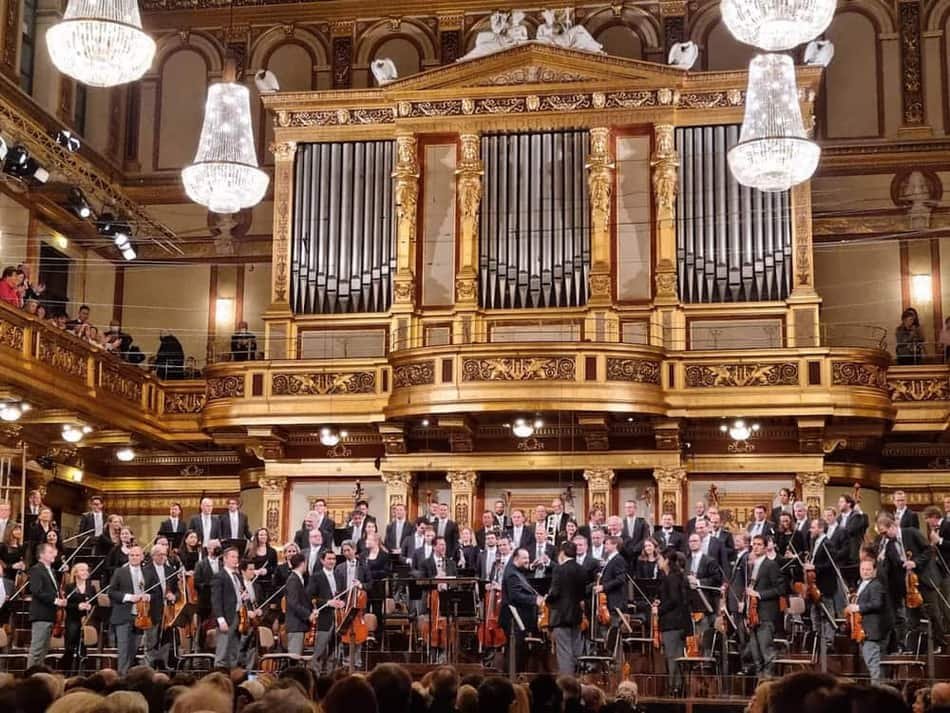
The Vienna Philharmonic was founded in 1842 by Otto Nicolai, whose former home is now the House of Music. Its members are drawn from the State Opera orchestra and it governs itself, choosing its own conductors. In 1870 it gained its home: the Golden Hall of the Musikverein, designed by Theophil Hansen and prized for acoustics that recordings never quite capture. The State Opera had opened on the Ring in 1869 with *Don Giovanni*; bombed in March 1945, it reopened in November 1955 with *Fidelio*. The Konzerthaus followed in 1913.
Johannes Brahms settled in Vienna in 1862 and Anton Bruckner arrived from Linz in 1868; the critics took sides in a bitter feud between their supporters. Then came Gustav Mahler, director of the Court Opera from 1897 to 1907, and Arnold Schoenberg with his pupils Berg and Webern, who took music beyond tonality — their story is in Vienna 1900.
An honest footnote. The world-famous New Year's Concert began on 31 December 1939, under Nazi rule, and the orchestra expelled and persecuted its Jewish members after 1938. The Philharmonic has published its own historians' research on this period.
Where to hear music today
- Opera: the State Opera runs one of the largest repertoires anywhere, with standing places sold on the day; see State Opera tickets. The Theater an der Wien concentrates on baroque and modern opera.
- Orchestral and chamber music: the Musikverein and the Konzerthaus, each with several halls and full seasons.
- Sacred music: the Vienna Boys Choir at Sunday Mass in the Hofburg chapel from September to June, and orchestral Masses in several city-centre churches on Sundays.
- Tourist concerts: Strauss and Mozart programmes in costume at the Kursalon and elsewhere are legitimate but designed for visitors. Buy tickets from the venue or an official agency, never from street sellers — the Vienna Tourist Board says so explicitly.
Our concerts hub lists venues and how to book, and classical concerts in Vienna explains how to choose.
Where the composers rest
Take tram 71 or 11 to the Central Cemetery in Simmering. In the group of honorary graves, Beethoven and Schubert — moved here in 1888 — lie side by side, near Brahms, Johann Strauss II and a memorial to Mozart, whose actual grave is lost in St. Marx. It is one of the most moving places in the city, and free.
An honest tip
You do not need a gala evening to hear great music in Vienna. A standing place at the Opera, a Sunday Mass or a student concert often delivers more than an expensive tourist show. Book the Philharmonic well ahead, and treat the man in the Mozart wig on Kärntner Strasse as local colour, not as a box office.
Where to stay nearby
Live prices and availability on a map centred on this exact spot — hotels, apartments and hostels, so you can judge the walk from here rather than guess from an address.
Bookings made through this map earn us a commission. Your price is unaffected.