Guides
Classical Concerts in Vienna: Where to Go, How to Buy, What to Avoid
Tony Denesa – Travel Advisor11 min read
The short version
Vienna is one of the few cities where a first-rate concert is not a special occasion but an ordinary evening. On any night of the season you can choose between a symphony orchestra in the Golden Hall of the Musikverein, a recital or contemporary programme at the Konzerthaus, an opera at the State Opera or the Theater an der Wien, and a light Strauss-and-Mozart programme designed for visitors. All of these are legitimate. The trick is knowing which one you are buying.
- For the real thing: check the programmes of the Musikverein and the Wiener Konzerthaus and buy on their own websites or at their box offices.
- For opera: the Vienna State Opera sells standing places for a few euros; our State Opera tickets guide explains the system.
- For an easy, cheerful evening: the Strauss and Mozart concerts at the Kursalon and in various palaces are fine — as long as you know it is a show for visitors, not the Vienna Philharmonic.
- Never buy from street sellers. The Vienna Tourist Board says so plainly, and the city has moved against the costumed "Mozart" sellers.
Our concerts page keeps the venues in one place; this guide explains how to choose between them.
The great halls
Musikverein
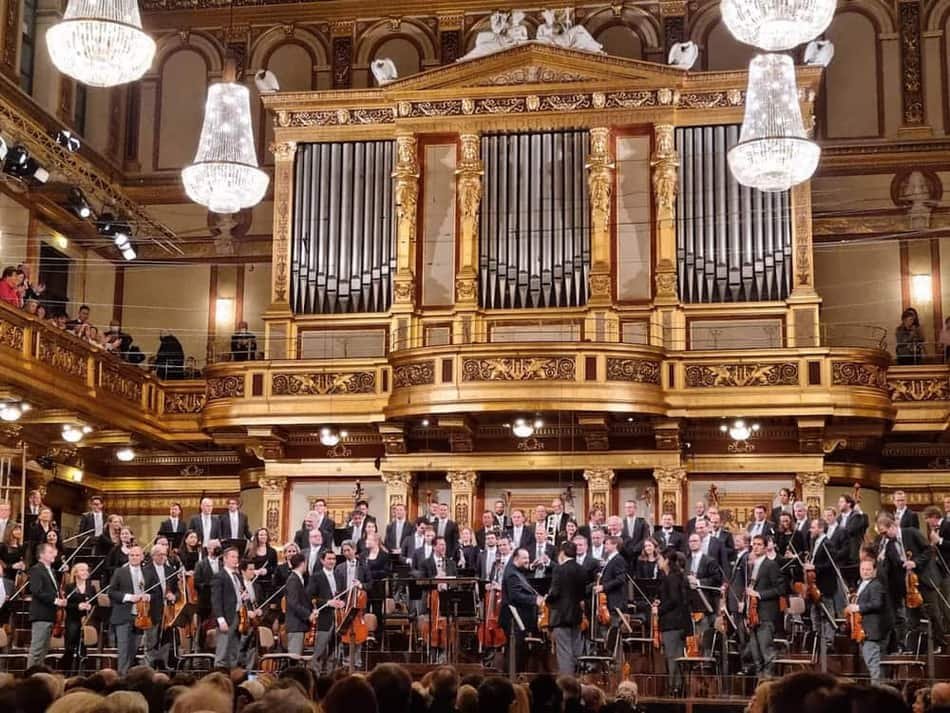
Opened in 1870 and designed by Theophil Hansen, the Musikverein is the home of the Vienna Philharmonic and the hall from which the New Year's Concert is broadcast every 1 January. Its Großer Saal, known as the Golden Hall, is famous for its acoustics: a long shoebox of gilded caryatids and wood that makes even a chamber orchestra sound warm and close. Next to it, the smaller Brahms-Saal hosts recitals and chamber music.
The Philharmonic's own subscription concerts are very hard to get into, but the Musikverein programme is far wider than one orchestra: visiting symphony orchestras, the Wiener Symphoniker, early-music ensembles, choirs and soloists fill the calendar from autumn to early summer. Buy through the Musikverein's own online shop or at the box office on Bösendorferstraße. Seats with restricted views exist at the sides of the hall; the seating plan on the official site shows them clearly, and they are often the best value if you care more about sound than sightlines.
The New Year's Concert on 1 January 2027 will be conducted by Tugan Sokhiev, his debut on that podium (announced by the Vienna Philharmonic). Tickets are allocated by an online registration and draw on the orchestra's website, months in advance — there is no other honest route in.
Wiener Konzerthaus
A short walk away, on the edge of the Stadtpark, the Konzerthaus (1913) is the Musikverein's more adventurous sibling. Its Großer Saal is larger and brighter, and the house programmes a wider range: symphonic cycles, song recitals, jazz, world music and a great deal of contemporary work, including the Wien Modern festival in November. If the Musikverein is where you hear Brahms as Vienna has always played him, the Konzerthaus is where you hear what comes next. It also has smaller halls — the Mozart-Saal and the Schubert-Saal — that are ideal for chamber music.
Opera houses
The Vienna State Opera plays a different production almost every night of the season, and its orchestra is, in its other life, the Philharmonic. The 435 standing places are Vienna's great musical bargain: they go on sale at the box office from 10:00 on the day of the performance, and holders of a Bundestheater Card with the "Standing Room PLUS" option (a one-off €28) can buy standing places for €4–7 online from 10:00 the day before (wiener-staatsoper.at, checked September 2026). Subtitles are available at every place. If you cannot go to a performance, the 40-minute guided tour costs €18.
The Theater an der Wien, where Beethoven's *Fidelio* had its premiere, now presents a season of opera in a much more intimate house — often baroque works and less familiar repertoire, very well done.
Mozart, Strauss and the visitor concerts
Every evening, somewhere in the Innere Stadt, an orchestra in period costume plays the *Blue Danube*, a Mozart overture and a few arias. The best known is the salon orchestra at the Kursalon in the Stadtpark, where Johann Strauss himself once conducted; others take place in palace halls and churches. These are real musicians and real concerts, and they can make a pleasant evening, especially with older relatives or children. What they are not is the Vienna Philharmonic, and they are priced for visitors rather than for the music.
Use this test: if the programme is a "best of" with waltzes and the *Radetzky March*, and the seller mentions the venue more than the performers, it is a visitor concert. If the programme names a conductor, soloists and complete works, it is a concert in the ordinary sense.
The street sellers
For years, young men dressed as Mozart have worked Stephansplatz, Kärntner Straße and the square in front of the Opera, selling tickets to these evenings — often at inflated prices, and sometimes implying that the concert is at the Opera or the Musikverein. According to press reports, the city banned costumed sellers from those streets from 1 July 2026. Whether or not you still meet one, the rule is simple: do not buy tickets on the street. The Vienna Tourist Board recommends buying directly from the venue or through established agencies such as oeticket, Wien-Ticket, Jirsa or allstarticket.
Churches, choirs and free music
- Vienna Boys Choir: the most authentic way to hear them is at Sunday Mass in the Hofburg Chapel at 09:15, from September to June, sung with members of the State Opera orchestra and chorus. Tickets for seats are sold online via the chapel's official site; read the details before you go, because this is a liturgy, not a concert. The choir also performs at its own hall, MuTh, on the edge of the Augarten.
- Churches: Sunday high masses at St. Stephen's, the Augustinian Church and other churches often use orchestral settings by Haydn, Mozart or Schubert. Attending a service is free; treat it as worship.
- Open-air: each summer the Vienna Philharmonic gives a free concert in the Schönbrunn gardens, usually in June, and the Rathausplatz film festival screens concert films for free in July and August.
Before and after the concert
- Dress: there is no formal dress code in the concert halls. Smart casual is normal; many Viennese dress up a little for the evening, especially at the Opera and the Musikverein. Leave large bags in the cloakroom.
- Arrive early: doors close when the music starts, and latecomers wait until the first break.
- Go deeper: the House of Music (€19, open until 22:00) is a good rainy-afternoon primer, and the Mozarthaus (€16) is the only surviving Vienna apartment of Mozart (both prices checked on the official sites, September 2026). For the story from Haydn to Mahler, read music in Vienna; for a pilgrimage, Beethoven, Brahms, Schubert and Strauss lie in the Central Cemetery.
- Supper: after a Musikverein concert, the classic move is a late bite at Café Sacher or a coffee house on the Ring. Plan your season with our events calendar.
Where to stay nearby
Live prices and availability on a map centred on this exact spot — hotels, apartments and hostels, so you can judge the walk from here rather than guess from an address.
Bookings made through this map earn us a commission. Your price is unaffected.