Guides
A Danube Cruise from Vienna: Which Boat Is Worth It, and Which Isn't
Tony Denesa – Travel Advisor10 min read
The short version
A boat on the Danube sounds like the most Viennese thing you can do. The honest truth is more nuanced: the river does not flow through the old town, and the most beautiful stretch of the Danube is not in Vienna at all but an hour upstream, in the Wachau valley. Choose the cruise by what you want to see.
- Best overall: a boat through the Wachau, between Melk and Krems — vineyards, castle ruins, baroque abbeys. It is a full day out; see our Wachau day trip guide.
- Best as transport: the Twin City Liner catamaran to Bratislava, 75 minutes from the Danube Canal in the centre. Go one way by boat, come back by train — details in our Bratislava day trip guide.
- City sightseeing cruises: pleasant with children or on a hot evening, but you will see more concrete embankments and bridges than palaces.
- Often better than any boat: an afternoon on the Danube Island or at the Alte Donau, where the Viennese actually go to be near the water.
First, understand Vienna's rivers
Vienna has several "Danubes", and most confusion starts here. The Danube Canal (Donaukanal) is the old, narrow arm of the river that runs along the edge of the Innere Stadt, past Schwedenplatz; this is where the city boats and the Bratislava catamaran leave from. The Danube itself (the main river) was straightened in the 1870s and runs a few kilometres further east, through a wide, engineered channel. Beyond it lie the long Danube Island and the New Danube, built as flood protection, and the Alte Donau, a calm former river arm that is now Vienna's favourite place to swim and row. The full story is in the Danube in Vienna.
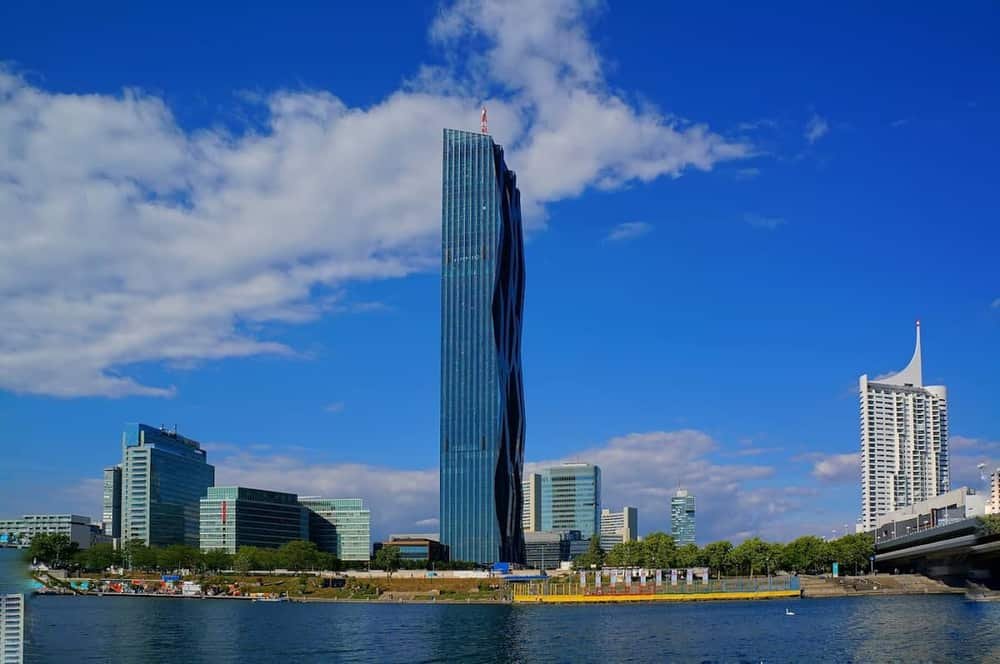
What this means for a cruise: from the water you see the city's modern face — the UNO City towers, the Danube Tower, bridges, locks, cycle paths and, along the canal, graffiti walls and summer bars. It is interesting, not romantic. Do not expect to glide past St. Stephen's.
City cruises in Vienna
Several operators, the best known being DDSG Blue Danube, run sightseeing boats in the season, typically from spring to autumn. Routes vary, but the classic one leaves from the Danube Canal near Schwedenplatz, passes through a lock and loops onto the main river before returning. Some sailings add lunch, dinner, brunch or music, and there are themed evening cruises in summer. Schedules and prices change by season, so check the operator's own timetable before you plan a day around it.
Worth it if: you are travelling with children who love boats and locks, you want a relaxed hour sitting down after a museum morning, or you like a dinner cruise with the lights of the modern city. Skip it if: you have only two or three days, or you want historic Vienna — a tram ride on the Ring shows you more in less time.
The Twin City Liner to Bratislava
The most useful boat in Vienna is not a sightseeing cruise at all. The Twin City Liner is a fast catamaran that leaves from the Schiffstation Wien City on the Danube Canal, between the Marienbrücke and the Schwedenbrücke, and reaches Bratislava in 75 minutes (wien.info, checked September 2026). It sails up to three times a day and only in the warmer part of the year. On the way you leave the canal, join the main river and pass the Donau-Auen national park, one of the last large floodplain forests in Central Europe, before the Bratislava castle appears on its hill.
It is not cheap compared with the train, and fares differ between weekdays and weekends, with a fuel surcharge added in 2026, so check the current price on the operator's site when you book. Seats sell out on summer weekends. The sensible plan is boat one way, train the other: the regional trains from Wien Hauptbahnhof take roughly an hour and run at least hourly.
The Wachau: the cruise that is worth a day
If you do one Danube cruise, make it this one. The Wachau, a UNESCO World Heritage landscape between Melk and Krems, is the river at its finest: terraced vineyards, apricot orchards, the blue baroque tower of Dürnstein and the ruined castle where Richard the Lionheart was held. Boats run between Melk and Krems in the season; downstream the trip takes roughly an hour and a half, upstream about twice as long. Most people take the train to Melk, visit the abbey, sail down to Dürnstein or Krems and take the train back to Vienna. Our Wachau day trip guide has the full plan.
River cruise ships
If you are arriving on a multi-day river cruise, your ship will most likely moor on the main Danube in Leopoldstadt or near the Reichsbrücke, not in the centre. Allow twenty to thirty minutes by U-Bahn to reach Stephansplatz. With one day ashore, use our one day in Vienna route; with a night, add a concert or a Heuriger evening.
Better than a boat: the water the Viennese use
- Danube Island: a car-free island more than 20 km long between the Danube and the New Danube, with swimming spots, cycle paths and summer bars. Take the U1 to Donauinsel or the U6 to Neue Donau. The Donauinsel is also home to the free Donauinselfest in summer.
- Alte Donau: the calm old arm of the river in Donaustadt, with lidos, rowing and pedal-boat rental in summer, and lakeside restaurants such as Das Bootshaus.
- Danube Tower: for the view rather than the water, the 150-metre Danube Tower in the Donaupark has express lifts and a revolving restaurant.
- Danube Canal: on summer evenings, the embankments near Schwedenplatz turn into a long outdoor bar. Eat at Otto am Donaukanal on the Leopoldstadt side, then walk.
Practical notes
- Season: most boats run from spring to October; in winter there is little or nothing on the water.
- Getting there: Schwedenplatz is on the U1 and U4. Remember that in 2026–27 the S-Bahn trunk line between Praterstern and Hauptbahnhof is closed until the end of October 2027, so plan with the U-Bahn — see getting around.
- Weather: the river is windy even on warm days; bring a layer, and check the weather — cruises can be cancelled in high water.
- Tickets: buy from the operator directly. If you want a hotel close to the water, where to stay in Vienna explains Leopoldstadt and the canal side.
Where to stay nearby
Live prices and availability on a map centred on this exact spot — hotels, apartments and hostels, so you can judge the walk from here rather than guess from an address.
Bookings made through this map earn us a commission. Your price is unaffected.