Guides
A Wachau Day Trip from Vienna: Melk, the Danube and Dürnstein by Train and Boat
Tony Denesa – Travel Advisor11 min read
The short version
If you add one day outside Vienna, make it the Wachau. This 30-odd-kilometre stretch of the Danube between Melk and Krems is a UNESCO World Heritage landscape of terraced vineyards, apricot orchards, castle ruins and baroque church towers, and it is easy to do on your own by public transport.
- The classic loop: train from Vienna to Melk → Melk Abbey → boat downstream to Dürnstein or Krems → train back to Vienna.
- Time needed: a full day, roughly 08:30 to 19:00.
- Season: best from April to October, when the boats run and the abbey is open daily. In spring the apricot trees blossom; in autumn the vineyards turn gold and the new wine arrives.
- Budget: Melk Abbey entry is €16 for adults, with a guided tour for €4 more (stiftmelk.at, checked September 2026). Add the train and the boat.
It is also the natural fifth day of a longer stay; see Vienna in five days.
Getting there
By train to Melk. Regional trains on the western line reach Melk in roughly an hour from Vienna, sometimes with a change at St. Pölten; check connections from Wien Hauptbahnhof or Westbahnhof in the ÖBB Scotty planner the evening before. From Melk station it is a short uphill walk to the abbey.
By train to Krems. Trains from Franz-Josefs-Bahnhof and Spittelau reach Krems, at the other end of the valley, in about an hour. This is your return route if you finish the day in Krems.
A 2026–27 warning. The central S-Bahn line between Praterstern and Hauptbahnhof is closed until the end of October 2027, which changes many local connections inside Vienna. Plan door to door in Scotty and allow extra time to reach the station; our train stations guide explains which station is which.
By car. Driving gives you freedom to stop in Spitz or Weißenkirchen, but you lose the boat, the best part of the day, and a glass of wine at lunch. If you drive, park in Melk and take the boat one way, then return by bus or taxi — or accept the drive along the river as the scenic part.
Melk Abbey
The yellow-and-white Benedictine abbey of Stift Melk sits on a rock above the river like a baroque ocean liner. Before the Habsburgs, this was a seat of the Babenberg rulers; the building you see was rebuilt in the early 18th century by Jakob Prandtauer. The visit leads through the imperial corridor and the museum rooms to the marble hall, the terrace with its view over the Danube, the library with its painted ceiling, and finally down a spiral staircase into the golden abbey church.
Practical: in the 2026 season, from 28 March to 1 November, the abbey is open daily; from April to October hours are 09:00–17:30, with last entry at 17:00. From November to March you can visit only on weekday guided tours (at 11:00, 13:30 and 15:00). Allow about two hours, and more if you walk the abbey park.
The boat down the Danube
From the landing stage below Melk, boats sail downstream through the heart of the Wachau to Spitz, Dürnstein and Krems. Going downstream the whole stretch takes roughly an hour and a half; going upstream against the current takes about twice as long, which is why almost everyone starts in Melk. Operators such as DDSG Blue Danube and Brandner run the route in the season, typically from spring to October, with only a few sailings a day. Build your day around the boat timetable, not the other way round: check it before you pick a train. Combined rail-and-boat tickets have been sold for this trip in past seasons, so ask ÖBB whether one is on offer when you book.
Sit on the left side of the boat going downstream for the best views of the villages on the north bank. You pass the Aggstein castle ruin high on the right, the church of Spitz among its vineyards, the fortified church of Weißenkirchen, and then the blue tower of Dürnstein appears around a bend — the photograph everybody takes. Our wider Danube cruise guide compares this trip with the boats in Vienna.
Dürnstein
Get off at Dürnstein, a walled village of one main street, pastel houses and wine shops. The blue-and-white baroque tower belongs to the former Augustinian canons' abbey; above the village, a steep path climbs to the ruin of the Kuenringer castle, where Richard the Lionheart was held captive on his way home from the Crusade in the 1190s. The climb takes about twenty to thirty minutes and the view over the river is the best in the valley. Wear proper shoes.
Dürnstein is busy at midday when the boats arrive; late afternoon is calmer. Taste the apricot specialities — jam, liqueur, Marillenknödel dumplings in summer — and the local wine.
Krems and Göttweig
Krems, at the eastern end of the valley, is a proper small town with a pedestrian old town, the medieval Steiner Tor gate and a cluster of museums in the Kunstmeile, including the Landesgalerie Niederösterreich. Across the river, the Benedictine abbey of Göttweig looks down from its hill. From Krems station, trains return to Vienna in about an hour, which makes Krems the easiest place to end the day.
Wine and apricots
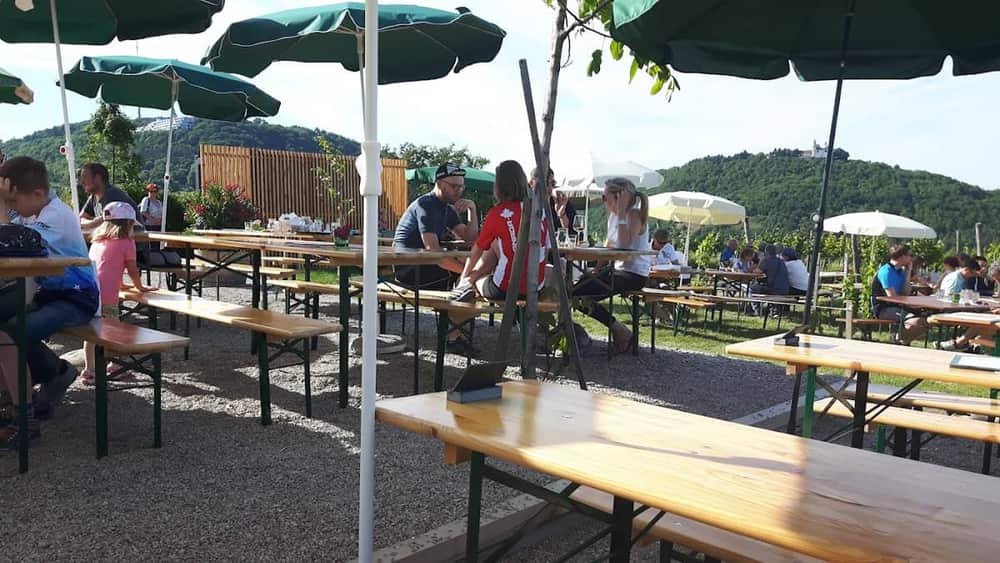
The Wachau is one of Austria's great white-wine regions, known for Grüner Veltliner and Riesling from steep stone terraces. Local growers classify their dry wines by ripeness as *Steinfeder* (light), *Federspiel* (medium) and *Smaragd* (the richest). Many wineries have a Heuriger that opens on set dates, just as in Vienna; if you enjoy the Wachau, continue the evening at a Viennese wine tavern — our Heuriger guide and the Heurigen page show where. Back in the Innere Stadt, the historic Melker Stiftskeller on Schottengasse carries the abbey's name.
Three ways to plan the day
- Train + boat + train (recommended). Early train to Melk, abbey at opening, lunch in Melk, afternoon boat to Dürnstein, walk up to the ruin, bus or taxi to Krems, train back to Vienna.
- Bike. The Danube Cycle Path runs along both banks and is almost flat. Rent a bike in Melk or Krems, ride one way and return by boat or train.
- Organised tour. Convenient, especially outside the boat season, but you will usually get less time in Dürnstein.
Before you go
- Apricot blossom usually comes in early spring, around late March or April; the harvest is in July. Check the weather for the week.
- Pack comfortable shoes and a layer for the boat deck.
- Connect the dots: the famous Venus of Willendorf, found in the Wachau in 1908, is on display in Vienna's Natural History Museum.
- More day trips: Bratislava is easier; Salzburg and Hallstatt are much further. Back in the city, where to stay in Vienna helps you pick a base near the right station.
Where to stay nearby
Live prices and availability on a map centred on this exact spot — hotels, apartments and hostels, so you can judge the walk from here rather than guess from an address.
Bookings made through this map earn us a commission. Your price is unaffected.