The city
The Siege of Vienna, 1683: Kahlenberg, Sobieski and the Croissant Myth
Tony Denesa – Travel Advisor10 min read
The short version
From 14 July to 12 September 1683, an Ottoman army under Grand Vizier Kara Mustafa Pasha besieged Vienna. The garrison, commanded by Count Ernst Rüdiger von Starhemberg, held out until a relief army led by King John III Sobieski of Poland and Duke Charles V of Lorraine came down from the hills of the Vienna Woods and broke the siege in a single day. It was the high-water mark of Ottoman expansion into central Europe, and the start of a war that pushed the Habsburg frontier deep into Hungary. It also produced a crop of legends — croissants, coffee, bagels — that the evidence does not support.
Why 1683
This was the second Ottoman siege. The first, under Suleiman the Magnificent in 1529, had failed. By the 1680s the Ottoman Empire was still the great power of south-eastern Europe, and a Hungarian uprising against the Habsburgs under Imre Thököly offered an opening. Kara Mustafa, ambitious and eager for a prize worthy of Suleiman, marched past the frontier fortresses and made for the imperial capital itself.
Emperor Leopold I left Vienna on 7 July with the court, ending up in Passau. Many Viennese thought the worse of him for it, but it kept the emperor free to assemble a coalition.
Two months inside the walls
Vienna in 1683 was a compact fortress city — roughly today's Innere Stadt — ringed by bastions, a moat and an open glacis. Starhemberg had burned the suburbs outside the walls so the attackers would have no cover. He commanded, by most estimates, around 11,000 soldiers and several thousand armed citizens, students and guild members. The Ottoman army, with its auxiliaries, was many times larger; figures vary widely, and well over 100,000 men is a common estimate.
Kara Mustafa did not have heavy siege artillery, so the Ottomans fought as they did best: with trenches and mines. Sappers tunnelled towards the Burg and Löwel bastions near the Hofburg and blew breaches in the walls, and the defenders dug counter-mines to meet them underground. Dysentery spread; Mayor Johann Andreas von Liebenberg died during the siege. By early September the city was starving and parts of the walls were close to collapse. From the tower of St. Stephen's Cathedral, the defenders fired signal rockets towards the hills, where they hoped a relief army was gathering.
12 September: the Battle of Kahlenberg
The relief army gathered north-west of the city: Polish troops under Sobieski, imperial forces under Charles of Lorraine, and contingents from Saxony, Bavaria and other German states — perhaps 70,000 to 80,000 men. Sobieski, as a crowned king, held overall command. A young officer named Eugene of Savoy rode with them; he would become the empire's greatest general.
Early on 12 September the Capuchin friar Marco d'Aviano, the papal envoy, said Mass on the heights. One honest complication for visitors: the hill then called Kahlenberg is the one now called Leopoldsberg, while today's Kahlenberg had a different name. The whole ridge above today's Döbling was the battlefield's starting line.
The allies fought their way down through the vineyards all day. In the late afternoon Sobieski launched the Polish cavalry, including the famous winged hussars, in one of the largest cavalry charges in history. The Ottoman camp broke. Kara Mustafa fled, leaving behind tents, standards, weapons, livestock — and sacks of coffee. He was executed on the sultan's orders in Belgrade that December.
What changed afterwards
The victory led to the Holy League of 1684 and the Great Turkish War. Within sixteen years the Habsburgs had retaken Buda and most of Hungary, confirmed at the Treaty of Karlowitz in 1699. Vienna, no longer a frontier fortress, could finally grow outwards. Aristocrats built summer palaces on the burned suburbs; the most spectacular is the Belvedere, built for Prince Eugene with the fortunes of the Turkish wars. The baroque city you see today is, in a real sense, the dividend of 1683 — the story continues in Habsburg Vienna.
Myths of 1683, checked
The croissant. The story goes that Viennese bakers, working at night, heard Ottoman miners digging, raised the alarm, and celebrated by baking crescent-shaped pastries. There is no contemporary evidence for any of it. The Austrian Kipferl, a crescent-shaped bread, is documented long before 1683, and the laminated French croissant is a nineteenth-century development. It is a charming tale told to tourists, not history.
Coffee and Kolschitzky. The favourite Viennese legend credits Georg Franz Kolschitzky, a courier who slipped through the Ottoman lines disguised in Ottoman dress, with receiving the abandoned coffee sacks as a reward and opening the city's first coffee house. Kolschitzky's courier mission was real; the coffee house is not documented. The first licence to serve coffee in Vienna went to an Armenian, Johannes Diodato, in 1685. Kolschitzky still has a street in Wieden and a statue at its corner — the legend was polished by the coffee-house owners of the nineteenth century. The full story is in the history of the Viennese coffee house.
The bagel. Sometimes credited to a Viennese baker honouring Sobieski's stirrups. Bagels are recorded in Kraków decades earlier. Another myth.
"The Turks introduced coffee to Europe in 1683." Coffee houses already existed in Venice, London and Paris before 1683. Vienna came to coffee a little late — and then made more of it than anyone.
Where to see 1683 today
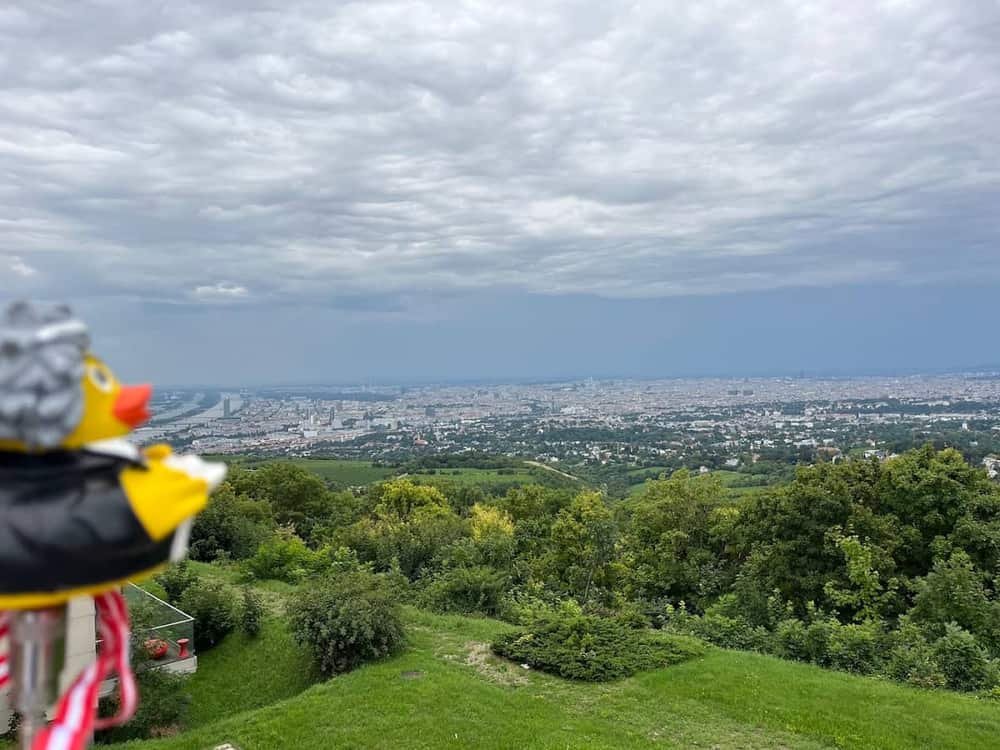
- Kahlenberg and Leopoldsberg — the ridge where the relief army formed. The church on Kahlenberg, cared for by a Polish community, keeps a chapel to Sobieski. On a clear day you see the whole basin the armies fought across. Bus 38A climbs from U4 Heiligenstadt; walk down through the vineyards to a Heuriger in Grinzing.
- Türkenschanzpark — the park in Währing is named after the Ottoman earthworks that stood here.
- St. Stephen's Cathedral — the great bell in the north tower, the Pummerin, was first cast in 1711 from captured Ottoman cannon. The original was destroyed in the fire of 1945; the present bell of 1951 was recast partly from its metal.
- Wien Museum Karlsplatz — the city museum's permanent exhibition, free to enter, covers the siege with plans, paintings and Ottoman objects.
- Museum of Military History — the Arsenal museum's early rooms deal with the Turkish wars.
- Capuchin Church — Marco d'Aviano, beatified in 2003, is buried here; the church stands above the Imperial Crypt, where Leopold I lies.
- Heldenplatz — the equestrian statue of Prince Eugene, the veteran of Kahlenberg, faces the Hofburg.
An honest note
For much of the nineteenth and twentieth centuries, 1683 was told in Vienna as a triumph of Christendom over "the Turk", and the imagery still surfaces in unpleasant ways. Historians now tell a more complicated story of two empires, shifting alliances — Thököly's Hungarians fought on the Ottoman side — and a city that, within a generation, was drinking coffee, wearing Ottoman fashions and collecting Ottoman art. That second story is the one the city's museums now tell, and it is the better one.
Where to stay nearby
Live prices and availability on a map centred on this exact spot — hotels, apartments and hostels, so you can judge the walk from here rather than guess from an address.
Bookings made through this map earn us a commission. Your price is unaffected.