The city
A Viennese German Primer: Grüß Gott, Schmäh and the Words You Need in a Café
Tony Denesa – Travel Advisor11 min read
The short version
You do not need German to enjoy Vienna: English is widely spoken, especially in hotels, museums and restaurants in the centre. But the Viennese do not speak the German of textbooks. Austria has its own standard vocabulary, and Vienna adds a dialect, Wienerisch, full of old borrowings from Czech, Hungarian, Italian, Yiddish and French — the linguistic memory of a multinational empire. Learn a dozen words and every coffee house, menu and wine tavern becomes easier, and people will warm to you.
- Say hello: Grüß Gott (formal) or Servus (friendly).
- Order coffee: Melange, Einspänner, Brauner.
- Read the menu: Erdäpfel, Paradeiser, Topfen, Schlagobers.
- Understand the mood: Schmäh, grantig, leiwand.
Greetings and politeness
- Grüß Gott ("God greet you") — the standard greeting in shops, offices and restaurants across Austria, at any time of day. Say it when you walk into a small shop; it is expected.
- Guten Tag — perfectly correct, but marks you as German or a visitor.
- Servus — hello and goodbye among friends and younger people. From the Latin for "(your) servant".
- Baba and Pfiat di (or *Pfiat Ihna*) — informal Viennese goodbyes. *Auf Wiedersehen* is the neutral version.
- Habe die Ehre and Küss die Hand — old-fashioned courtesies you will still hear from elderly waiters and shopkeepers. Enjoy them.
- Bitte does many jobs: please, you're welcome, and "here you are". Danke is thanks; Entschuldigung is excuse me.
Sie or du? Use the formal *Sie* with anyone you do not know, including staff. The Viennese also love titles: a doctor is *Herr Doktor* or *Frau Doktor*, and professional titles such as *Magister* or *Ingenieur* often appear on doorbells. You will not be expected to use them, but it explains the ceremony.
Wienerisch: the words that explain the city
- Schmäh — the untranslatable Viennese blend of charm, irony, banter and tall stories. "Einen Schmäh führen" means to joke around; "Das ist ein Schmäh" means it is a con or a joke.
- grantig — grumpy. The famous Viennese waiter's gruffness is called *Grant*; it is rarely personal.
- raunzen — to grumble for the pleasure of it, a local art form.
- leiwand — great, cool.
- Oida — literally "old man", used as mate, dude, or an exclamation of surprise or exasperation, depending on tone.
- Heast! — hey, listen!
- Na geh! — oh, come on!
- Passt schon — it's fine, don't worry.
- Hawara — mate, buddy.
- Beisl — a traditional neighbourhood inn; the word is said to come from Yiddish.
- Bussi — a kiss on the cheek, also a friendly sign-off.
For centuries Vienna drew people from across Central Europe, and you still see Czech, Hungarian and Slavic surnames everywhere. Our Habsburg Vienna tells that story. The most prestigious Austrian stage German, meanwhile, is jokingly called *Burgtheaterdeutsch*, after the Burgtheater.
Pronunciation in one minute
- w is pronounced like English *v*: Wien sounds like "Veen".
- ei sounds like "eye", ie like "ee": *Wein* (wine) is "vine", *Bier* is "beer".
- sch is "sh", z is "ts", ß is "ss": *Straße* is "shtrah-sseh".
- ä, ö, ü — close enough if you say "e", "er" and "ew".
In the coffee house
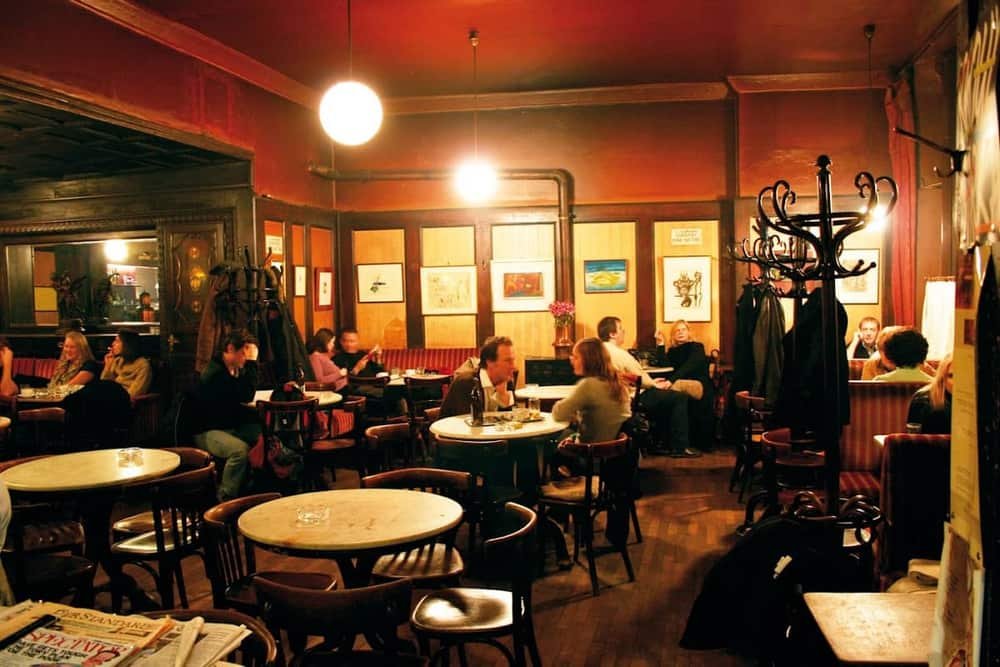
The coffee house has its own vocabulary, and a Viennese waiter will appreciate your using it. Read our coffee-house etiquette guide for the rituals and the coffee-house history for the background.
- Herr Ober — the traditional way to address the waiter (short for *Oberkellner*, head waiter).
- Melange — espresso with steamed milk and milk foam; the Viennese default.
- Kleiner / Großer Schwarzer — a single or double espresso, black.
- Kleiner / Großer Brauner — the same with a little cream or milk on the side.
- Verlängerter — an espresso lengthened with hot water.
- Einspänner — a strong black coffee in a glass under a cap of whipped cream.
- Kapuziner — a black coffee with a dash of cream, the colour of a Capuchin's habit.
- Schlagobers or Obers — whipped cream or cream. *Mit Schlag* means "with whipped cream".
- Zahlen, bitte! — the bill, please. The waiter who took your order usually brings it, and you tip by rounding up.
A glass of water comes with your coffee, and nobody will rush you. Try it at Café Sperl or Café Landtmann; the full list is on our coffee houses page.
On the menu: Austrian words for food
When Austria joined the European Union in 1995, its accession treaty included a protocol recognising 23 Austrian food terms alongside their German equivalents — a sign of how seriously the difference is taken. The table mixes protected terms with other everyday Austrian words you will meet:
| Austrian | Germany | English | |---|---|---| | Erdäpfel | Kartoffeln | potatoes | | Paradeiser | Tomaten | tomatoes | | Karfiol | Blumenkohl | cauliflower | | Kren | Meerrettich | horseradish | | Topfen | Quark | curd cheese | | Marillen | Aprikosen | apricots | | Fisolen | grüne Bohnen | green beans | | Faschiertes | Hackfleisch | minced meat | | Ribisel | Johannisbeeren | currants | | Semmel | Brötchen | bread roll | | Obers | Sahne | cream |
Add Palatschinken (thin pancakes), Powidl (thick plum jam), Knödel (dumplings), Nockerl (small dumplings) and Essiggurkerl, the little sour gherkins served with a Brettljause. Our guide to what to eat in Vienna puts the words on a plate. At a sausage stand such as Bitzinger, ask for Senf, süß oder scharf (sweet or hot mustard).
At the wine tavern
- Ausg'steckt — "hung out": a pine branch over the gate means the Heuriger is open.
- Achterl / Vierterl — an eighth or a quarter of a litre of wine.
- G'spritzter — wine with sparkling water; *sauer gespritzt* means with soda water rather than lemonade.
- Sturm — cloudy, partly fermented young wine, sold in early autumn.
- Brettljause — a wooden board of cold meats, spreads and cheese.
- Stamperl — a small shot glass for schnapps.
Practise at a real Heuriger with our Heuriger guide and the Heurigen page.
Getting around
- Bim — the tram, named after its bell.
- Öffis — public transport. Our getting around guide explains tickets.
- Trafik — a tobacconist-newsagent, which also sells transport tickets and parking vouchers.
- Stiege and Stock — staircase and floor. An address such as "Stiege 2, 3. Stock" leads you through a courtyard to a particular staircase.
- Jänner and Feber — January and February, Austrian style.
A Romanian footnote
Romanian travellers will recognise much of this. Through centuries of Habsburg rule in Transylvania, Banat and Bukovina, Austrian German gave Romanian words such as *șnițel*, *ștrudel*, *șpriț*, *halbă*, *ștrand*, *șuncă* and the regional *fain*, and in parts of Transylvania tomatoes are still *paradaise* — straight from Viennese *Paradeiser*. More practical tips for Romanian visitors are on our page for Romanians, and the essentials for everyone on the practical info page.
Where to stay nearby
Live prices and availability on a map centred on this exact spot — hotels, apartments and hostels, so you can judge the walk from here rather than guess from an address.
Bookings made through this map earn us a commission. Your price is unaffected.