The city
Red Vienna: The Social City of the Gemeindebauten
Tony Denesa – Travel Advisor10 min read
The short version
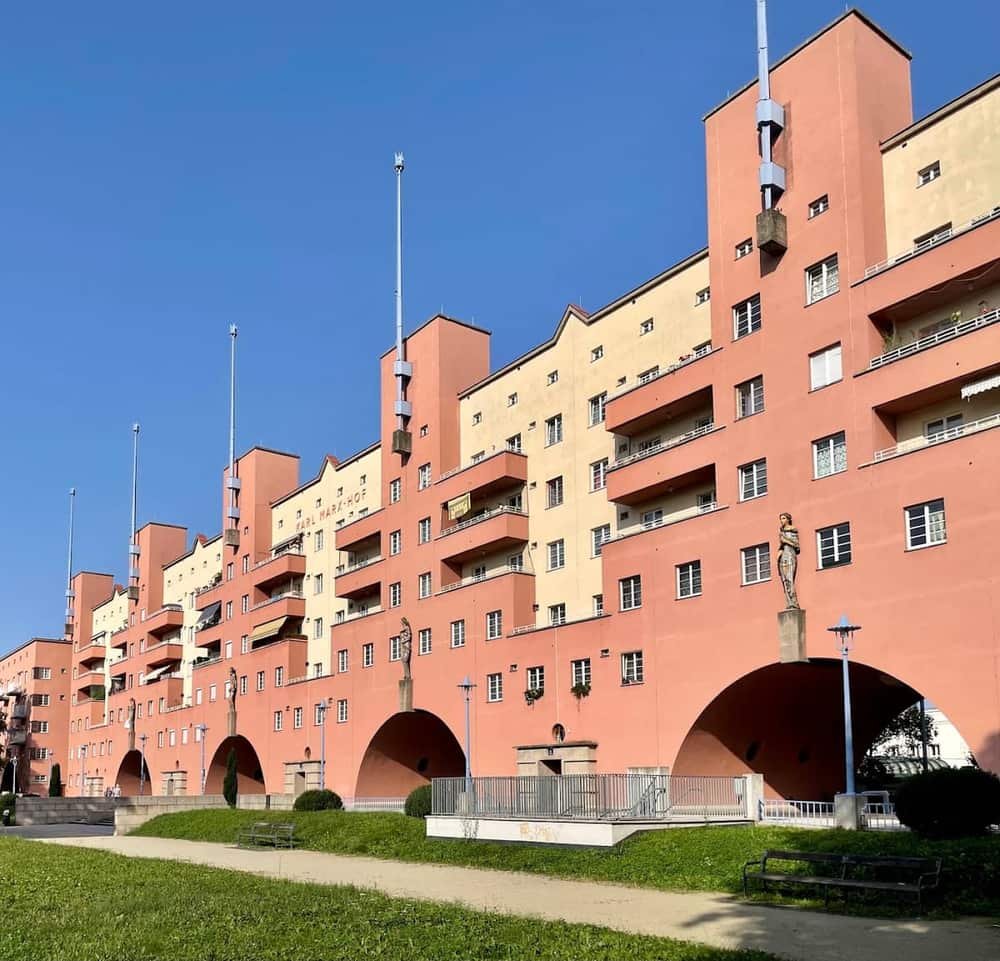
Red Vienna (*Das Rote Wien*) is the name for the years 1919 to 1934, when the Social Democratic Workers' Party governed the city with an absolute majority and turned it into one of the most ambitious experiments in municipal socialism anywhere. Its most visible legacy is housing: the Gemeindebauten, municipal apartment blocks built around green courtyards with laundries, kindergartens, libraries and clinics. The best known, the kilometre-long Karl-Marx-Hof, was shelled by government artillery in February 1934. Nearly a century later, Vienna still owns an enormous stock of public housing, and visitors who look beyond the palaces find a second, equally remarkable city.
From imperial capital to hungry city
In November 1918 Vienna went from capital of an empire of some fifty million people to capital of a small republic of about six and a half. The city was starving, cold and overcrowded. Before the war, working-class families often lived in one or two rooms without running water, sharing a tap and toilet in the corridor, and many rented their beds by the shift to "bed-goers" (*Bettgeher*). Tuberculosis was known abroad as the "Viennese disease".
In May 1919 the first municipal elections held under universal suffrage, including women, gave the Social Democrats an absolute majority. Jakob Reumann became the city's first Social Democratic mayor, followed in 1923 by Karl Seitz. In 1922 Vienna was separated from Lower Austria and became a federal state in its own right, which gave the city the power to raise its own taxes. That detail made everything else possible.
Paying for it: Breitner's taxes
The finance councillor Hugo Breitner built the budget on steeply progressive levies: taxes on luxury goods and services — servants, private cars, horses, champagne, nightclubs, large apartments — and, from 1923, a dedicated housing construction tax (*Wohnbausteuer*) that fell overwhelmingly on the most valuable properties. Rent control, introduced during the war, had collapsed the value of private land, so the city could buy plots cheaply. Housing was built without debt.
Look up at the façade of almost any interwar municipal block and you will still see the red lettering stating that it was built by the City of Vienna, with the years, from the proceeds of the housing construction tax.
What they built
Between 1923 and 1934 the city built more than 60,000 flats in around 400 projects. The flats were small by modern standards, typically 38 to 48 square metres, but every one had running water, its own toilet, gas and electricity, and daylight. Just as important was what surrounded them: courtyards and gardens occupying most of the site, central laundries with mechanical dryers, bathhouses, kindergartens, mothers' advice centres, dental clinics, lending libraries, workshops and meeting halls.
The social programme went well beyond housing. Julius Tandler ran public health and welfare, from infant layettes for every newborn to school dental care and the fight against tuberculosis. Otto Glöckel reformed the schools. The city built public baths such as the tiled Amalienbad in Favoriten, open-air pools, sports grounds and, in 1931, the stadium in the Prater for the Workers' Olympiad — today's Ernst Happel Stadium. The philosopher-planner Otto Neurath invented picture statistics to explain it all to voters.
The Karl-Marx-Hof
The flagship is the Karl-Marx-Hof in Heiligenstadt, in Döbling. Designed by Karl Ehn, a pupil of Otto Wagner, and built between 1927 and 1930, it stretches for about 1.1 kilometres along a single street and originally held some 1,380 flats. Only around a fifth of the plot is built on; the rest is garden. Its central section, with great arches and flagpole towers painted red and ochre, faces the square opposite the U4 and S-Bahn station at Heiligenstadt, so you step straight out of the train in front of it.
One of the building's original central laundries now houses a small museum on Red Vienna, run with the city; it opens on limited days, so check before you go. From here it is a short walk to Mayer am Pfarrplatz, one of the classic Heurigen of the old wine village.
1927 and 1934: the end
Red Vienna was an island. The national government was conservative, the countryside Catholic and hostile, and both sides kept paramilitary forces: the Social Democrats' Republican Protection League and the right-wing Heimwehr. On 15 July 1927, after a court acquitted right-wing men who had shot dead a veteran and a child, protesters set fire to the Palace of Justice and police killed scores of people.
In 1933 Chancellor Engelbert Dollfuss shut down parliament and ruled by decree. On 12 February 1934 a police search of the Social Democrats' headquarters in Linz triggered armed resistance, and fighting spread to Vienna's municipal blocks. The army shelled the Karl-Marx-Hof and other Gemeindebauten with artillery. After four days the uprising was crushed; the party was banned, leaders were executed or fled, and Mayor Seitz was removed from City Hall. The square in front of the Karl-Marx-Hof is now called 12.-Februar-Platz. Four years later came the Anschluss — the story continues in Vienna 1938–1955.
The legacy today
After 1945 the city returned to municipal housing and never really stopped. The city's housing company manages around 220,000 municipal flats, and a much larger stock of subsidised cooperative housing sits alongside them, which is a major reason rents in Vienna are low for a Western European capital and the city regularly tops quality-of-life rankings. Even the Hundertwasser House in Landstrasse, completed in 1985, is a municipal housing block. The contemporary descendants are new quarters such as Seestadt Aspern in Donaustadt.
A Red Vienna itinerary
- Karl-Marx-Hof, Döbling: take the U4 to Heiligenstadt. Walk the full length, visit the laundry museum if it is open, finish at a Heuriger.
- The "Ringstrasse of the Proletariat", Margareten: along the Margaretengürtel, a chain of blocks including the palatial Reumannhof (1924–26) by Hubert Gessner and the earlier Metzleinstaler Hof, one of the very first municipal blocks.
- Rabenhof, Landstrasse: a dense, romantic complex of 1925–28 with its own theatre.
- Sandleitenhof, Ottakring: the largest interwar complex, almost a small town, with its own library, shops and meeting spaces.
- Amalienbad, Favoriten: the grand public bath of 1926 on Reumannplatz, still in use.
- Werkbundsiedlung, Hietzing: a 1932 model estate of small modernist houses coordinated by Josef Frank, a different, more individual answer to the same question.
Most of these are free to look at from the street and courtyards. For architectural context, see the Vienna architecture guide, and for more districts that repay the trip, Vienna beyond the centre. Transport details are on getting around.
Visiting etiquette
These are homes, not museums. Many courtyards are open passages, but keep your voice down, do not enter stairwells or laundries uninvited, do not photograph residents or their windows, and leave drones at home. A small group on a guided walk is welcome; a large one blocking a doorway is not.
An honest note
Red Vienna has admirers and critics, and both have a point. The flats were tiny, allocation depended on a points system that party membership did not hurt, and the fortress-like blocks were read at the time — not only by opponents — as political strongholds. Its leaders, several of them Jewish, were also targets of vicious antisemitic propaganda. But it transformed the lives of hundreds of thousands of people within a decade, and its core idea — that good housing is public infrastructure — is still what makes Vienna unusual. Compare it with the palaces of Habsburg Vienna; both are the city's heritage.
Where to stay nearby
Live prices and availability on a map centred on this exact spot — hotels, apartments and hostels, so you can judge the walk from here rather than guess from an address.
Bookings made through this map earn us a commission. Your price is unaffected.