Blog
Vienna Beyond the Centre: Places That Earn the U-Bahn Ride
Tony Denesa – Travel Advisor12 min read
The short version
Vienna has 23 districts, and nine out of ten visitors spend their whole stay in one of them — the Innere Stadt — plus quick raids on Schönbrunn and the Belvedere. That is a pity, because the city's character lives further out: in wine villages inside the city limits, in one of Europe's grandest cemeteries, in street markets where Turkish, Serbian and Viennese stallholders shout over each other, and in buildings as extraordinary as anything on the Ring. Public transport is fast and frequent, so almost everything below is 15 to 40 minutes from Stephansplatz. We have grouped the places by what they give you, and said plainly who should skip them. For the full list of neighbourhoods, see districts; for routes and tickets, getting around.
For the dead and the great: Zentralfriedhof and St. Marx
The Central Cemetery in Simmering opened in 1874 and is one of the largest in Europe, a landscaped city of the dead with avenues, deer and hares. Near the main gate, the honorary graves in Group 32A gather Beethoven, Schubert, Brahms, both Johann Strausses and a memorial to Mozart. Behind them rises the Jugendstil cemetery church (1908–1911) by Max Hegele. By the first gate lies the old Jewish section, thousands of leaning stones, many untended because the families who would have cared for them were murdered or driven out after 1938 — a quiet place that deserves time. Take tram 71 or 11; allow at least two hours.
Mozart himself was buried in 1791 in an unmarked grave in the small Biedermeier St. Marx Cemetery in Landstrasse. No one knows exactly where; a broken column and a mourning angel mark the approximate spot. Go in spring when the lilac is out.
Skip if: cemeteries depress you. Don't skip if: you care about music at all.
For Wagner's masterpiece: Steinhof
On a hill in Penzing, inside the grounds of a psychiatric hospital built in 1907, stands the Kirche am Steinhof, Otto Wagner's church with a copper-gilded dome, white marble cladding and mosaics and windows designed by Koloman Moser. Inside, everything was planned for the patients: a sloping floor for easy cleaning, rounded pew ends, a separate entrance for men and women. It is a place of beauty with a dark shadow: during the Nazi period the hospital was a site of murder of patients and children, remembered in a memorial exhibition on the grounds. Opening hours are limited, so check with the Wien Museum before going. Our Jugendstil walk covers Wagner's buildings in the centre.
For wine with a view: Döbling, Floridsdorf and Mauer
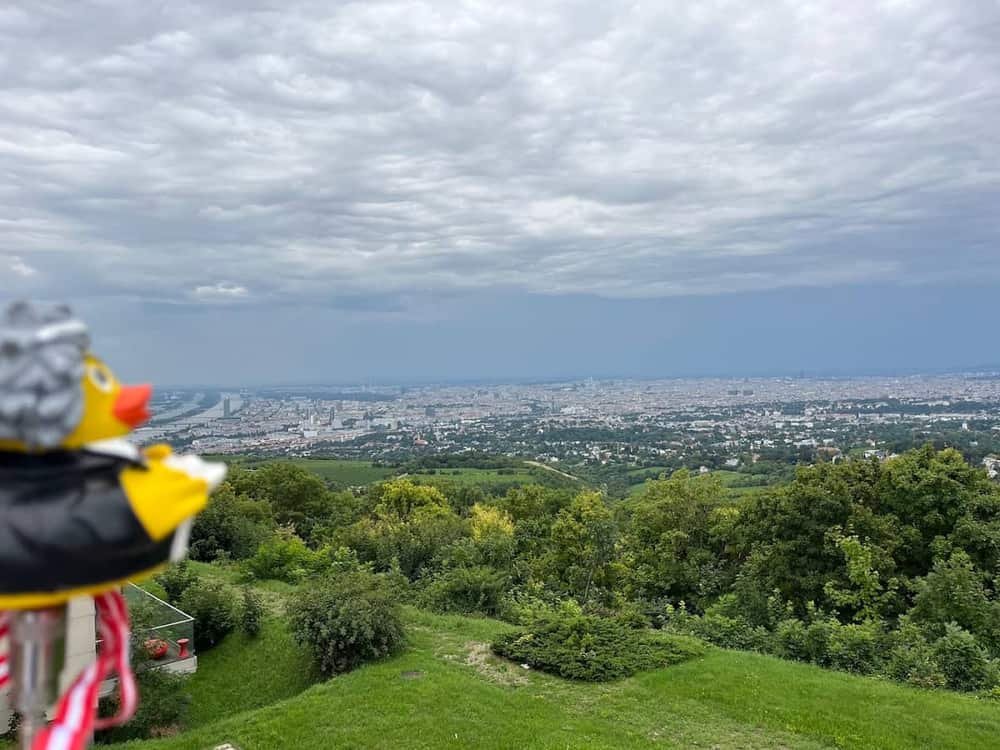
Vienna is a wine city, not just a city with wine bars. The northern slopes of Döbling are covered in vineyards, and the villages of Grinzing, Nussdorf, Sievering and Neustift am Walde are full of Heurigen, the taverns where growers serve their own wine. Grinzing is the most famous and the most touristy; Nussdorf and Neustift feel more local. From the Kahlenberg viewpoint you see the whole city, the Danube and, on a clear day, far out over the Vienna Basin; this is where the relief army gathered before the battle of 1683.
In Heiligenstadt, the Beethoven Museum occupies the house where the composer wrote his despairing Heiligenstadt Testament in 1802, and the Mayer am Pfarrplatz Heuriger sits in another house he lived in. On the way, look at the kilometre-long Karl-Marx-Hof, the icon of Red Vienna.
Across the Danube in Floridsdorf, the Stammersdorfer Kellergasse is a rural lane of wine cellars dug into the hillside, with simple taverns and almost no tourists. In the south, Liesing has the Maurer Heurigen and the startling Wotruba Church (1974–1976), a stack of 152 concrete blocks by the sculptor Fritz Wotruba. Read our Heuriger guide before you go: most taverns open only on rotating dates.
For markets and everyday Vienna: Ottakring and Leopoldstadt
The Brunnenmarkt in Ottakring is one of the longest street markets in the city, strongly shaped by Turkish and former-Yugoslav families: fruit piled high, bakeries, grill smoke, cheap fresh herbs. At its end, Yppenplatz has turned into a lively square of cafés and wine bars. Uphill in the same district, the Kuffner Observatory (1884–1886) holds public viewing evenings, and Café Ritter Ottakring is a proper suburban coffee house.
In Leopoldstadt, across the Danube Canal, the Karmelitermarkt is smaller and more polished, best on Saturday mornings. This was the historic heart of Jewish Vienna, a story told in Jewish Vienna. A short walk north, the Augarten is the city's oldest Baroque garden, opened to the public by Joseph II in 1775. It holds the Augarten porcelain manufactory, founded in 1718, the home of the Vienna Boys' Choir, and two enormous concrete flak towers of 1944–1945, too massive to demolish. The other way, the Prater Hauptallee runs in a straight chestnut-lined line for more than four kilometres from near the Giant Ferris Wheel.
Skip if: you only have one day. Don't skip if: you want to see how Viennese people actually shop and eat.
For curious minds: Alsergrund
The 9th district, Alsergrund, is a university and hospital quarter full of oddities. The Sigmund Freud Museum is at Berggasse 19, where Freud lived and worked until he fled in 1938. The Josephinum, Joseph II's academy for military surgeons of 1785, keeps a haunting collection of Florentine anatomical wax models. In the old General Hospital grounds, the round Narrenturm of 1784 — one of the first buildings in the world designed for the mentally ill — now houses a pathological-anatomical collection. Walk down the Jugendstil Strudlhofstiege staircase (1910) and into the lanes of the Servitenviertel, then see the Baroque Liechtenstein Garden Palace, whose interiors open only on limited tours. The reforming emperor behind half of this is the subject of Maria Theresa and Joseph II.
For architecture that breaks the rules: Landstrasse and Simmering
In Landstrasse, the Hundertwasser House (1983–1985) is a riot of colour, uneven floors and trees growing out of windows. It is a council housing block, so you can only look from outside; the KunstHausWien museum nearby is the place to go in. Honest note: the shopping arcade opposite, Hundertwasser Village, is mostly souvenirs.
Further out in Simmering, the four Gasometers were brick gas holders of 1896–1899, converted around 2001 by four architects — Jean Nouvel, Coop Himmelb(l)au, Manfred Wehdorn and Wilhelm Holzbauer — into flats, offices and a shopping mall. It is a fascinating piece of urban recycling, less exciting as a day out.
For water and air: Donauinsel, Alte Donau and the Danube Tower
On hot days the Viennese head to Donaustadt. The Donauinsel is a 21-kilometre artificial island built between the 1970s and 1980s as flood protection, now a long strip of beaches, cycle paths and bars. The Alte Donau, an old arm of the river cut off by the regulation of the 1870s, is calmer, with lidos, rowing boats and lakeside restaurants. The Danube Tower in the Donaupark has observation decks and a revolving restaurant roughly 150 metres up. All of it is covered in our guide to Vienna in summer.
For imperial green without the crowds: Hietzing
Everyone goes to Schönbrunn; few continue into Hietzing itself. Gustav Klimt, Otto Wagner and Koloman Moser are buried in the Hietzing Cemetery beside the palace wall. Café Dommayer stands on the site of the casino where Johann Strauss the younger made his debut in 1844. And to the west, the vast Lainzer Tiergarten, the former imperial hunting ground, hides the Hermesvilla that Franz Joseph built for Empress Elisabeth in the 1880s.
How to plan it
- Pick one outer area per day, combined with something central. Heiligenstadt and the Heurigen pair well with an afternoon; the Zentralfriedhof with a morning.
- Check transport before you set off. The S-Bahn core line between Praterstern and Hauptbahnhof is closed until the end of October 2027, so use U-Bahn and trams; details on getting around.
- Mind the calendar. Heurigen open on rotating dates, the Steinhof church and Liechtenstein palace only at set times, and markets are closed on Sundays.
- Stay beyond the Ring if you like this kind of travel: see where to stay in Vienna and the stay listings.
Where to stay nearby
Live prices and availability on a map centred on this exact spot — hotels, apartments and hostels, so you can judge the walk from here rather than guess from an address.
Bookings made through this map earn us a commission. Your price is unaffected.