Guides
Kunsthistorisches Museum Tickets: Price, Time Slots and What to See
Tony Denesa – Travel Advisor10 min read
The short version
The Kunsthistorisches Museum — the Museum of Fine Arts, always shortened to KHM — is the Habsburgs' private collection turned into a public museum, and it is the single best art museum in Vienna. Two things you need to know before you go:
- A ticket costs €22 bought online, €24 bought at the desk. Prices checked on khm.at, September 2026.
- Since 8 September 2026 every visit requires a pre-booked time slot. You can no longer simply turn up, pay and walk in. Book the slot on khm.at, even if you intend to buy at the counter.
- Under 19s go free, as at every Austrian federal museum. Bring ID for teenagers.
- Closed Mondays. Tuesday to Sunday 10:00–18:00, with a late evening on Thursday until 21:00.
If you only have time for one museum in Vienna and you like paintings, this is the one. If you like paintings *and* strange precious objects, it is not even close.
The time slot, explained
This is the change that catches people out in 2026. The museum used to sell an open ticket; from 8 September 2026 every visitor books a fixed entry time. In practice:
- Go to khm.at, choose the date, choose a slot.
- You enter within that slot. Once inside, you can stay as long as you like until closing — the slot controls arrival, not the length of your visit.
- The online price (€22) is lower than the on-site price (€24), so booking ahead saves money as well as trouble.
Which slot to pick. The first slot of the day at 10:00 is the calmest, and it gives you the Bruegel room before the tour groups reach it. The Thursday evening extension to 21:00 is the museum's best-kept secret: from roughly 18:00 the building empties, the light through the dome goes soft, and you get the Kunstkammer almost alone. If your Vienna days are full, plan the KHM for a Thursday evening and you effectively gain a free afternoon elsewhere.
What is actually inside
The KHM is enormous and trying to see all of it is a mistake. Four things justify the ticket.
The Bruegel room. The museum holds the largest collection of paintings by Pieter Bruegel the Elder anywhere in the world — the Habsburgs bought them early and kept them together. *The Hunters in the Snow*, *The Tower of Babel*, *The Peasant Wedding*, *The Fight Between Carnival and Lent*: they hang in one room, at eye level, with no glass between you and the panel. People come to Vienna for this room alone and leave having spent an hour in it. Budget accordingly.
The Kunstkammer. Twenty rooms of the imperial "chamber of art and wonders" — the cabinet of curiosities that European princes assembled in the sixteenth and seventeenth centuries, here on a scale nobody else can match. Automata, carved rock crystal, ivories, clockwork, bezoars mounted in gold, and Benvenuto Cellini's Saliera, a gold salt cellar made for the King of France in the 1540s and famously stolen from the museum in 2003 and recovered in 2006. The Kunstkammer is the most underrated part of the building; most visitors run out of energy before they reach it, which is an argument for doing it first.
The picture gallery. Beyond Bruegel: Vermeer's *The Art of Painting*, Rubens by the room, Velázquez portraits of the Spanish infantas painted to be sent to their Viennese cousins, Titian, Raphael, Caravaggio, Arcimboldo's composite heads made of fruit and fish. The Habsburgs married into half of Europe and inherited the art, which is why a museum in Vienna owns the Spanish royal portraits.
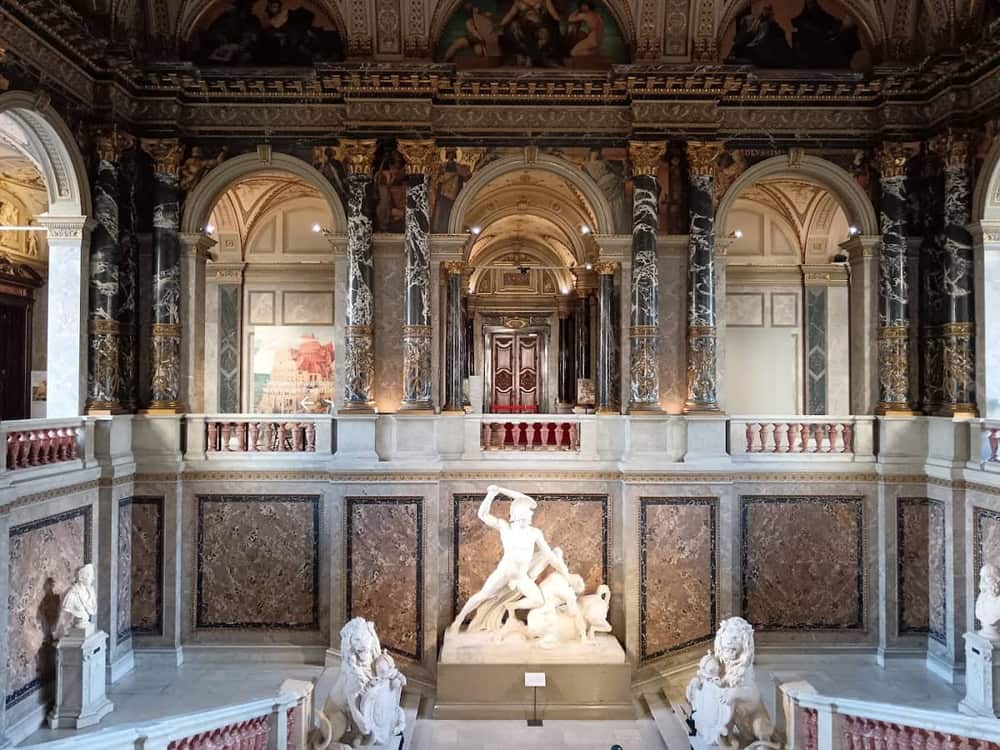
The building itself. Gottfried Semper and Carl von Hasenauer built it in 1891 on the new Ringstrasse as one of a matched pair with the Natural History Museum opposite. The grand staircase carries Klimt's early work: the young Gustav Klimt, his brother Ernst and Franz Matsch painted the figures in the spandrels between the columns, and you can see the moment a decorative painter starts becoming something else. Look up before you look at anything else.
Prices in 2026
Adult prices from khm.at, checked September 2026:
| Ticket | Price | |---|---| | Kunsthistorisches Museum, online | €22 | | Kunsthistorisches Museum, at the desk | €24 | | Under 19 | Free |
The KHM is one institution spread across several buildings, and it sells combined tickets that add the other sites to the main house on Maria-Theresien-Platz. The most useful of these covers the main building plus the Neue Burg collections inside the Hofburg — the Collection of Historic Musical Instruments, the Arms and Armour, and the Ephesos Museum, all under one roof ten minutes' walk away. The combined and annual tickets change more often than the single admission, so check the current price and what is included on khm.at before you buy; we are not quoting a figure we have not verified this month.
Is the combination worth it? For most visitors, no — one building is already a full morning. It earns its place for two kinds of traveller: anyone interested in early instruments (the Neue Burg has keyboards Beethoven and Haydn played, and the room is quiet in a way the KHM never is), and anyone staying four days or more who wants to split the visit across two mornings. If that is you, see the Hofburg and Sisi Museum guide as well — the Neue Burg sits in the same complex but is a completely separate ticket from the Sisi Museum.
What is not included: nothing in the MuseumsQuartier across the road. The Leopold Museum (Schiele, Klimt) and mumok are separate institutions with separate tickets.
How long it takes
- 90 minutes — Bruegel room, the greatest hits of the picture gallery, the staircase. Tight but honest.
- 2 to 2.5 hours — the realistic figure. Picture gallery plus the Kunstkammer, with a coffee.
- Half a day — if you are the sort of person who reads labels. You will not be bored.
Two hours is what we recommend to almost everyone. The KHM punishes completism: the collection is so dense that the last hour of a four-hour visit is worth less than the first twenty minutes of a second visit.
A route that works. Enter, stop on the staircase for the Klimt spandrels and Canova's *Theseus*, go up to the picture gallery first while you are fresh, do the Bruegel room, then come down to the Kunstkammer on the way out. Doing it the other way round means arriving at Bruegel with tired feet.
The café under the dome
The museum café sits on the first floor directly under the cupola, in the octagonal domed hall, with marble, gilding and a view straight up into the dome. It is one of the most beautiful places to drink a coffee in Vienna and it is not a tourist trap — Viennese people come here for breakfast without visiting the museum, and there are cakes and a proper lunch menu.
Two practical notes: you generally need a museum ticket to reach it during museum hours, and it is at its best mid-morning or on the Thursday evening opening, when the room is half empty. If you want the Viennese café experience rather than a museum café, Café Museum — the 1899 room with an Adolf Loos interior — is six minutes away on Operngasse, and the coffee house etiquette guide explains how ordering works before you sit down.
Getting there
The museum stands on Maria-Theresien-Platz, on the Ring between the Hofburg and the MuseumsQuartier.
- U-Bahn: U2 Museumsquartier is the closest stop, a two-minute walk across the square. U2/U3 Volkstheater is the same distance on the other side. U1/U2/U4 Karlsplatz is about ten minutes on foot past the Opera.
- Tram: lines 1, 2 and D run along the Ringstrasse and stop at Burgring, directly outside.
- On foot: ten minutes from St. Stephen's Cathedral through the Innere Stadt, five from the Vienna State Opera.
Single tickets and passes are the same across the whole city network; the getting around guide covers what to buy, and the prices page puts the museum fare in context with everything else you will pay for in Vienna.
What to combine it with
Everything worth seeing is within a short walk, which makes this one of the easiest half-days in the city to plan.
- Across the square: the Natural History Museum, the KHM's architectural twin, with the 30,000-year-old Venus of Willendorf. Excellent with children.
- Across the road: the MuseumsQuartier courtyards, free to walk into, with the Leopold Museum and cafés in the Baroque stables.
- Five minutes east: the Hofburg, the Austrian National Library State Hall and the Albertina.
- In November and December: the Christmas Village fills Maria-Theresien-Platz between the two museums, 20 November to 26 December 2026 — see the Christmas markets guide.
If art is the reason you came to Vienna, read the museums guide to choose between the KHM, the Belvedere and the Leopold, and the Jugendstil walk for the city that produced Klimt. For the imperial side of the same story, the palaces page gathers Schönbrunn, the Hofburg and the Belvedere in one place, and the Schönbrunn ticket guide handles the other big pre-booked queue in this city. If you are keeping an eye on the budget, the free things to do guide lists what costs nothing within the same few streets, and the attractions hub has everything else.
Honest advice
Skip the KHM if you are in Vienna for two days and museums are not your thing — the concerts page and a Heurigen evening will give you more Vienna per hour. Skip it also if you are travelling with under-eights: the Natural History Museum opposite is the better room for them, and the Vienna with kids guide explains why.
But if you care about paintings at all, this is a world top-ten museum with a mid-range price, free entry for teenagers and, on a Thursday evening, almost nobody in it. Book the slot, arrive at 18:00, and do not leave before the Kunstkammer.
Where to stay nearby
Live prices and availability on a map centred on this exact spot — hotels, apartments and hostels, so you can judge the walk from here rather than guess from an address.
Bookings made through this map earn us a commission. Your price is unaffected.