Guides
Prater and the Riesenrad: What Costs Money and What Does Not
Tony Denesa – Travel Advisor10 min read
The short version
The first thing to understand about the Prater is that it is two completely different places sharing one name, and only one of them charges you anything.
- The Prater itself — the park — is free. It is a huge former imperial hunting ground, open day and night, with no gate, no ticket and no closing time. Walking in costs nothing, and always has.
- The Wurstelprater — the funfair inside it — is also free to enter. There is no admission, no wristband, no day pass. You pay per ride, at each ride, in cash or by card at the booth.
- The Riesenrad, the Giant Ferris Wheel, is a separate paid attraction with its own entrance, its own queue and its own ticket — commonly reported at around €14–15 for an adult, though the wheel's official site loads its prices through a shop widget we could not read when we checked in September 2026. Confirm on wienerriesenrad.com or at the booth before you queue.
That structure matters. A family can spend a whole afternoon in the Prater and pay for nothing but an ice cream, or spend €80 in ninety minutes. Both are normal. What you spend is entirely a function of how many times somebody says yes.
The Riesenrad
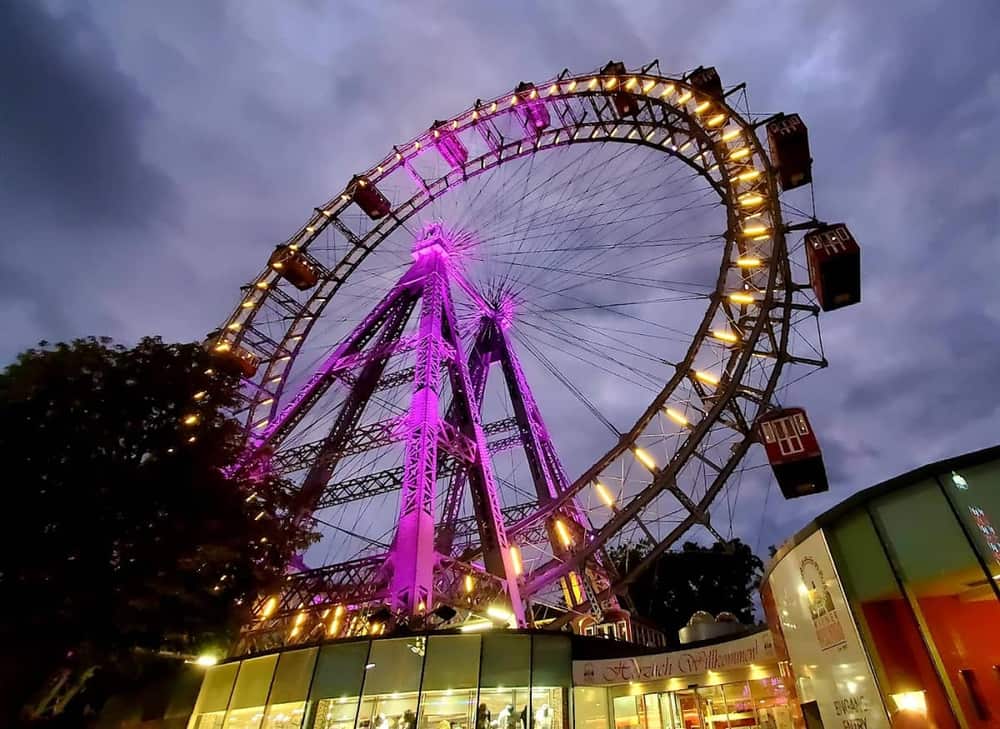
The Wiener Riesenrad went up in 1897, built by the English engineer Walter Basset for the golden jubilee of Emperor Franz Joseph, and it was meant to be temporary. It survived a demolition permit, both wars and a fire in 1945 that burned it to the steel. It was rebuilt with 15 cabins instead of the original 30, which is why the wheel looks slightly sparse in old photographs and slightly sparse now — the gaps are the war.
It is not tall by modern standards, about 65 metres to the top, and it turns slowly: one full rotation takes roughly a quarter of an hour. That is the point. The cabins are wooden, they hold a group rather than a couple, and you walk around inside them while the city rotates past. The view is best towards the Innere Stadt, with the spire of St. Stephen's Cathedral standing up out of the roofscape, and on a clear day out over the Danube to the Kahlenberg hills.
Is it worth it? If you want a view of Vienna, the honest answer is no — the Danube Tower is more than twice as high, the Kahlenberg viewpoint is free, and the south tower of St. Stephen's puts you over the old city itself. You ride the Riesenrad for what it *is*, not for what you see from it: a 129-year-old machine that appears in *The Third Man*, in a hundred postcards and in the mental image of Vienna that most visitors arrive with. Ride it once, for that, and do not expect a skyline.
Dinner in a cabin. Several cabins are fitted out as private dining and event rooms, bookable through the wheel's own operator for a meal or a proposal while it turns. It is expensive and it is a fixed booking, not something to decide in the queue. Prices are quoted on request — ask the operator directly.
When the queue is worst
The Riesenrad has one entrance and one line, and it moves in pulses — the cabins fill, the wheel turns, nobody moves for fifteen minutes. So the queue is either nothing or forty minutes, with very little in between.
Worst: Saturday and Sunday afternoons from about 14:00, warm summer evenings around sunset, the week between Christmas and New Year, and any public holiday. Sunset is the single most crowded slot of the year in July and August, because everybody has the same idea at the same time.
Best: weekday mornings — the wheel opens early and for the first hour or two you can often walk straight on. A weekday in the rain is almost as good and the cabins are enclosed anyway. In winter, late afternoons on a weekday are quiet and the city lights up while you are at the top, which is arguably the best ride of the year.
If you arrive and the queue is long, walk away and come back. The funfair is thirty seconds in any direction and nothing else in it has a queue like that.
The Wurstelprater — what the rides cost
The Wurstelprater is the old-fashioned amusement park around the wheel: roughly 250 attractions, family-run for generations, with no unified operator and therefore no single ticket. Each ride has its own booth and its own price, generally in the €3–8 range for the small rides and higher for the big towers and coasters — we are giving a range rather than a figure because there is no published central price list and every stand sets its own tariff. Look at the board before you get in line; they all display prices.
What is there:
- Prater Turm — the chain swing tower, one of the tallest of its kind in the world, which spins you out over the park at more than 100 metres. Better views than the Riesenrad and considerably more frightening.
- Ghost trains and old-fashioned rides — the Prater's real character. Several date from the mid-twentieth century, hand-painted, gloriously unsafe-looking and completely safe.
- Liliputbahn — the miniature steam and diesel railway that has run since 1928, about four kilometres through the green Prater. Cheap, charming, and the single best thing here for small children.
- Madame Tussauds Vienna — a full-price indoor attraction at the edge of the funfair, with Austrian figures alongside the international ones. Book online if you want it; it is not a Prater ride.
- Beer gardens, sausage stands and shooting galleries — the Wurstel in Wurstelprater is the sausage, and the food is part of the point.
The funfair season runs roughly mid-March to the end of October, with many stands also opening for the Christmas market on Riesenradplatz and around New Year. Outside the season the park is still there, still free, still full of joggers; the rides are shuttered. Individual opening dates vary by stand, so check before making a special trip in March or November.
The free Prater, which is the better one
Most visitors never leave the couple of hundred metres around the wheel, and they are missing the thing Viennese people actually come for. The Grüner Prater — the green Prater — is a very large public park stretching from Praterstern almost to the Danube.
- Prater Hauptallee — a dead-straight avenue of chestnut trees running 4.4 kilometres from Praterstern to the Lusthaus, closed to cars. In the morning it is full of runners; on a Sunday afternoon it is full of families, cyclists and people on inline skates. This is where the Vienna City Marathon finishes. Walking it end to end takes about an hour each way; renting a bike and riding it is better.
- The meadows and woods off the avenue, which are genuinely wild in places and were imperial hunting ground until Joseph II opened them to the public in 1766 — an act of civic generosity that is still the reason there is no gate.
- Ernst Happel Stadium, Austria's national stadium, inside the park.
- The Danube at the far end, and from there the Donauinsel for swimming in summer.
All of that costs nothing, which is why it heads our free things to do in Vienna list alongside the city's parks and free museums.
With children
The Prater is the best few hours in Vienna for a child, and it is also where a family budget quietly evaporates. What works:
- Under 5: the Liliputbahn, the carousels near the wheel, and the playgrounds along the Hauptallee. Skip the Riesenrad — a fifteen-minute slow rotation in a glass box is a long time for a three-year-old.
- 6 to 10: the ghost trains, the small coasters, the bumper cars. This is the age the Wurstelprater was built for. Set a number of rides before you go in and say it out loud; the stands are designed to make you lose count.
- Teenagers: the Prater Turm and the bigger drop towers, and then the Danube.
- Rainy days: Madame Tussauds and the indoor attractions, or leave the Prater entirely for the Natural History Museum.
The Vienna with kids guide sets the Prater against the zoo at Schönbrunn and Haus des Meeres, which are the other two obvious family days, and the palaces page is where to go when the adults want their turn.
Schweizerhaus
If you do one thing in the Prater that is not a ride, make it Schweizerhaus. It is a vast open-air beer garden under chestnut trees, open only for the warm season — traditionally from mid-March to the end of October — and it is a Viennese institution rather than a tourist stop. Czech Budweiser Budvar poured from the barrel, and Stelze: a roasted pork knuckle, ordered by weight, brought to the table whole with mustard, horseradish and gherkins. Order one between two people unless you are very hungry, and get the potato pancakes.
It is loud, it is communal, you share a table, and on a warm evening it is one of the happiest rooms in the city. No bookings for small groups on the terrace as a rule — turn up, walk in, look for space. Bring cash as a fallback.
Getting there
- U-Bahn: U1 or U2 to Praterstern. Come up the stairs and the wheel is directly in front of you, a two-minute walk. This is the one attraction in Vienna where the transport is genuinely idiot-proof.
- From the airport: the new VAB5 airport bus terminates at Praterstern — useful if you are staying in Leopoldstadt. Note that the S-Bahn trunk line through Praterstern is closed from September 2026 until the end of October 2027, so ignore older advice that routes you by S-Bahn; the airport transfer guide has the current options.
- Tram: line 1 and line O serve Praterstern; tram 1 continues along the Ring.
- On foot: twenty-five minutes from St. Stephen's Cathedral across the Danube Canal.
Transport tickets are the standard city fare — see the getting around guide — and the prices page shows where a funfair afternoon sits against everything else Vienna will charge you for.
An honest plan
Here is what we would actually do. Arrive at Praterstern on a weekday morning. Ride the Riesenrad straight away while there is no queue, and pay for it without agonising — it is a fifteen-minute ride you will remember. Then walk away from the funfair, down the Hauptallee, for half an hour under the chestnuts. Come back for lunch at Schweizerhaus if it is between March and October, or a sausage stand if it is not. Let the children have three rides, agreed in advance. Leave by mid-afternoon, before the crowds and before the money.
For the rest of a first visit, the one day in Vienna route puts the Prater in its place against the imperial centre, Vienna in summer covers the Danube side of the same district, the concerts page takes over the evening, and the attractions hub has everything we have not mentioned. If you want the reason the Riesenrad is famous outside Vienna, it is in the story of the occupied city — the 1938 to 1955 chapter covers *The Third Man* and the ruins the wheel was rebuilt out of.
Where to stay nearby
Live prices and availability on a map centred on this exact spot — hotels, apartments and hostels, so you can judge the walk from here rather than guess from an address.
Bookings made through this map earn us a commission. Your price is unaffected.