Guides
Haus der Musik Tickets: Price, the Virtual Conductor and Who It Suits
Tony Denesa – Travel Advisor9 min read
The short version
Haus der Musik — the House of Music — is Vienna's museum of sound: five floors in a Baroque palace behind the Opera, half of it about the Vienna Philharmonic and the great Viennese composers, half of it a hands-on sound laboratory where you play with noise.
- A ticket costs €19 for an adult. Checked on hdm.at, September 2026.
- It is open daily 10:00–22:00, with last entry at 21:00. That is the single most useful fact on this page: almost nothing else in Vienna is open at nine in the evening, and a museum you can visit after dinner is worth more than its price suggests.
- It sells a combined ticket with Mozarthaus Vienna, which is a seven-minute walk away and costs €16 on its own (checked on mozarthausvienna.at, September 2026). Ask for the combination at either desk; the joint price is set by the two houses and we are not quoting a figure we have not confirmed this month.
- It is the best museum in Vienna for a child aged roughly 7 to 14, and the one most likely to disappoint a purist.
What a visit is actually like
The building is worth ten seconds of context. This is Seilerstätte 30, the former city palace of Archduke Charles, and Otto Nicolai founded the Vienna Philharmonic here in 1842. The museum opened in 2000 and it is privately run, which shows in the production values: this is a designed, lit, sound-engineered space, not a room of glass cases.
You climb it floor by floor, and the floors are genuinely different from one another.
The ground floor and the Philharmonic. The first proper floor belongs to the Vienna Philharmonic — the New Year's Concert, the history, the famous drum of the ball at which the orchestra decides its own membership, and the lottery drum used to allocate New Year's Concert tickets. If you have ever watched that broadcast on 1 January, this is the room where it becomes real. The music in Vienna chapter has the background.
The Sonosphere. The strangest floor and the one people remember. It is about sound itself before it becomes music: what a foetus hears in the womb, how the ear works, instruments you hit and bow and blow, a room where you make a piece out of recorded street noise, and installations that turn your own voice into something else. Children stay here far longer than their parents expect. Adults pretend they are being patient and then spend twenty minutes on the same machine.
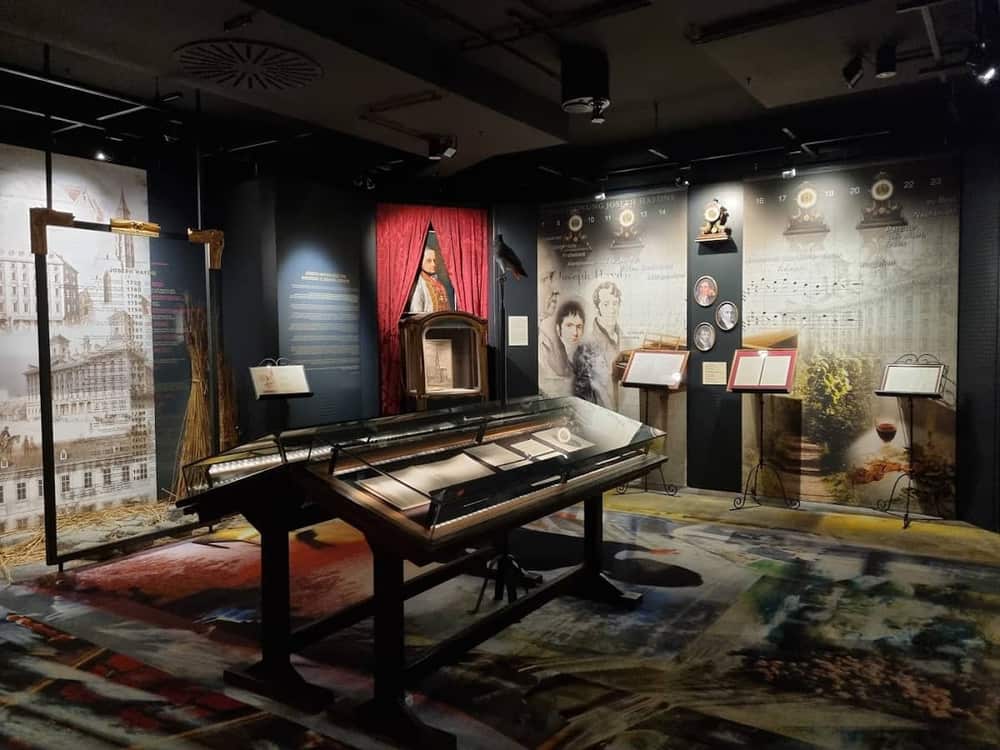
The composers' floor. Haydn, Mozart, Beethoven, Schubert, Johann Strauss, Mahler — a room each, with manuscripts, objects and audio. It is compact and well done, and it is not a substitute for the houses where these men actually lived. If the composers are your reason for coming, go to Mozarthaus and the Beethoven sites instead, and treat this floor as a summary.
The virtual conductor. The top floor, and the thing everybody comes for.
The virtual conductor, honestly
You pick up a baton in front of a life-size screen of the Vienna Philharmonic, choose a piece — the Blue Danube, the Radetzky March, a Mozart overture — and conduct. Sensors read the baton. The orchestra follows your tempo and your dynamics: beat faster and they play faster, beat bigger and they play louder, lose the pulse entirely and the performance falls apart in front of you.
And then the musicians stop and complain. Conduct badly enough and a player puts down the instrument and tells you, on screen, in the tone of a professional who has been asked to do something unreasonable, that this is not working. It is the best joke in any museum in Vienna, and it is also a genuinely good lesson: two minutes with the baton teaches you more about what a conductor does than an hour of reading.
The practical bit. There are only a couple of these stations and there is usually a queue, especially between about 14:00 and 18:00 in high season and on rainy afternoons. If it is busy, go up to the top floor first and do the rest of the museum afterwards — everything else is walk-through. In the last hour of the evening, after about 20:30, it is often free.
Prices in 2026
| Ticket | Price | |---|---| | Haus der Musik, adult | €19 | | Mozarthaus Vienna, adult | €16 | | Combined Haus der Musik + Mozarthaus | Sold at both desks — ask for the current price |
Adult prices checked on hdm.at and mozarthausvienna.at in September 2026. Both houses publish reduced rates for children, students and seniors on their own sites; family tickets exist and are worth asking about at the desk, because a family of four at full adult price is not the right way to buy this museum.
Opening hours. Haus der Musik daily 10:00–22:00, last entry 21:00. Mozarthaus daily 10:00–19:00. Neither closes on a Monday, which makes the pair a useful answer to the Monday problem — the Kunsthistorisches Museum and most of the big federal collections are shut that day.
Is the combination worth it? Only if you were going to Mozarthaus anyway. The two are seven minutes apart on foot through the Innere Stadt and they do not overlap: Haus der Musik is about sound and the orchestra, Mozarthaus is the actual apartment on Domgasse where Mozart lived from 1784 to 1787 and wrote *The Marriage of Figaro*. Together they make a complete music morning. Bought as a pair by somebody who only really wanted one of them, the combination saves a few euro and costs two hours.
Who it suits
Go if:
- You have children between about 7 and 14. This is the single best paid attraction in Vienna for that age. They touch everything, they make noise, nobody tells them off. The Vienna with kids guide ranks it against the Prater and the zoo.
- It is raining, or it is 20:00 and everything else is closed. The late opening is the museum's real advantage and it is why we keep recommending it as an evening.
- You are going to a concert this trip and want to understand what you are about to hear. An hour here before a Musikverein evening is genuinely useful preparation — see the classical concerts guide.
- You have three days or more. On a two-day trip it does not make the cut.
Skip it if:
- You are a serious classical listener. You will find the composers' floor thin and the interactive floor beside the point, and €19 is roughly what a good seat in the gallery or a cheap evening at the Konzerthaus costs. Spend it on hearing an orchestra instead of simulating one. The State Opera ticket guide explains how the standing places work, which is cheaper still.
- You are in Vienna for 48 hours. The Kunsthistorisches Museum, the Belvedere and the palaces come first, every time.
- Your children are under five. There is a lot of reading and the best installations need a certain patience; the Prater is the better afternoon.
How long, and how to get there
Allow 90 minutes to two hours. Ninety minutes is enough if you go straight up and work down; two hours if there are children with you, because they will not leave the Sonosphere. It is a five-floor climb with lifts, and there is a café at the top with a view over the rooftops of the first district.
Getting there. Haus der Musik is at Seilerstätte 30, 1010, in the Innere Stadt, behind the Opera.
- U-Bahn: U1/U3 Stephansplatz, five minutes on foot, or U1/U2/U4 Karlsplatz, seven minutes past the Opera.
- Tram: lines 2, 71 and D along the Ring, stop Schwarzenbergplatz or Oper.
- On foot: four minutes from the Vienna State Opera, six from St. Stephen's Cathedral.
The getting around guide covers what transport ticket to buy, and the prices page puts €19 in context against the rest of a Vienna day.
What to pair it with
Everything here is inside ten minutes' walk, which makes a very tidy music half-day:
- Mozarthaus Vienna on Domgasse — the combined ticket, and the only Mozart apartment in the city that survives.
- Musikverein — the Golden Hall, five minutes away; short guided tours run most days except Sundays and holidays.
- Vienna State Opera — the guided tour is €18 and takes about 40 minutes, or stand at the back of a performance for a few euro.
- Café Frauenhuber on Himmelpfortgasse, two minutes away, which claims to be Vienna's oldest coffee house and where Mozart and Beethoven both performed in the building.
- The concerts page for the evening that should follow all of this, and the attractions hub for what else is within the Ring.
For the wider picture, the museums guide places Haus der Musik among the city's fifty-odd collections, and Vienna in winter explains why a museum open until 22:00 matters more in December than in June.
Where to stay nearby
Live prices and availability on a map centred on this exact spot — hotels, apartments and hostels, so you can judge the walk from here rather than guess from an address.
Bookings made through this map earn us a commission. Your price is unaffected.