The city
From Horse Trams to the U-Bahn: A History of Vienna's Public Transport
Tony Denesa – Travel Advisor10 min read
The short version
Vienna's public transport is today one of the most admired in Europe — punctual, dense, affordable and used by locals of every class. It did not arrive that way. The city's history of moving people is a story of horse-drawn beginnings, an imperial showpiece railway designed by a great architect, an enormous tram network, a long hesitation about going underground and, finally, a U-Bahn built late but built well.
- 1860s: the first horse-drawn trams.
- 1890s: electric trams and the Stadtbahn, with stations designed by Otto Wagner.
- Early 1900s: the city takes the trams into municipal ownership.
- 1920s: the Stadtbahn is electrified; the tram network becomes one of the largest in the world.
- 1960s: the S-Bahn core line and the first tram tunnels.
- 1970s: the decision to build a U-Bahn; the U4 and U1 open.
- 2010s–2030: extensions to the edge of the city, and a new automated U5 line under construction.
Horses, omnibuses and the first trams
Before the railway age, Vienna moved on foot, by carriage and by the horse-drawn cabs known as Fiaker, which still wait for visitors on Stephansplatz. As the city grew in the nineteenth century, horse-drawn omnibuses appeared, followed in 1865 by the first horse tramway, running on rails from the city's edge towards the suburbs. Rails made horse traction far more efficient, and private companies spread their lines along the main roads leading out of the old town.
The real transformation came after the demolition of the city walls and the building of the Ringstrasse from the late 1850s. The new boulevard — the story is told in the Ringstrasse — gave the trams a grand circular route, and lines along the Ring remain part of the network today.
Electricity, and the city takes control
In the 1890s Vienna's first electric trams began to run, and within a few years electricity replaced horses across the network. At the same time, the city's politics changed. Under Mayor Karl Lueger, Vienna brought gas, electricity and then the tram network into municipal ownership in the years around 1900 — an unusually ambitious programme of public utilities for its time. The municipal trams expanded rapidly, reaching deep into the growing working-class districts.
By the interwar years, Vienna had one of the largest tram networks in the world. During the period of Red Vienna, affordable public transport was part of the social-democratic city's promise, alongside housing, baths and schools. Even today, the tram network is among the most extensive anywhere.
Otto Wagner's Stadtbahn: a railway as a work of art
In the 1890s the imperial and municipal authorities agreed to build a Stadtbahn — a city railway — to link the suburbs, the railway stations and the Danube, partly for military logistics. The engineering was conventional steam railway; the architecture was not. Otto Wagner was commissioned to design the entire visual language of the line: stations, bridges, viaducts, tunnels, railings and lamps.
Wagner's Stadtbahn, opened in stages from 1898, is one of the founding works of Viennese modernism. Along the Gürtel, his stone viaducts carry trains on arches that today house bars and music venues. Along the Wien river, his stations mark the way towards Schönbrunn. At Hietzing, he built a special Court Pavilion for Emperor Franz Joseph, a lavish waiting room the emperor reportedly used very rarely.
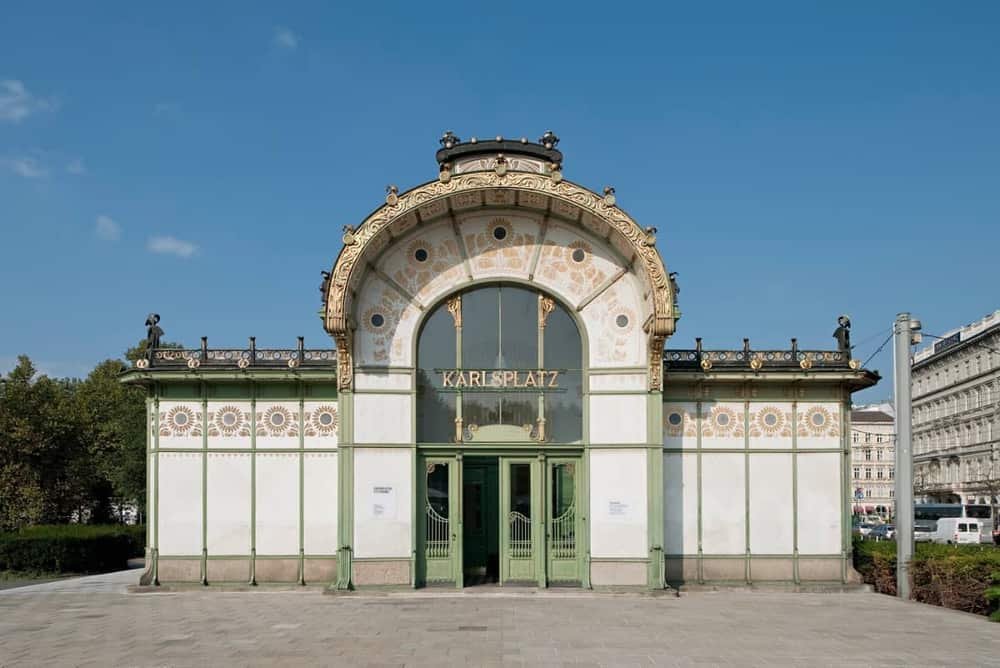
The most famous of all are the two Otto Wagner pavilions on Karlsplatz, with their white marble panels, green iron frames and gilded sunflowers. When the U-Bahn was built beneath the square in the 1970s, there were plans to demolish them; instead they were dismantled, restored and rebuilt at a higher level. One now serves as a café and the other as a small Wien Museum exhibition space. Beneath them, the modern Karlsplatz station is the hub where the U1, U2 and U4 meet.
For the wider story of Wagner, the Secession and Viennese modernism, read Vienna 1900, and follow our Jugendstil walk, which passes his Majolikahaus and Postal Savings Bank.
The Stadtbahn's steam trains were never popular — smoky, slow and expensive. In 1925 the city electrified the main lines and integrated them with the tram fares, which finally made the railway part of everyday Viennese life.
War, occupation and the car age
The Second World War left the network badly damaged, and the postwar decade of four-power occupation — the Vienna of *The Third Man*, described in Vienna 1938–1955 — was a time of improvisation. Once the occupation ended in 1955, a new debate began, as it did across Europe: should the city make room for cars? Several tram lines were replaced by buses in the 1950s and 1960s, and traffic engineers imagined wide roads through the inner districts.
Vienna chose a middle path. In 1962 the S-Bahn core line (the Stammstrecke) opened, running north–south through the city between Floridsdorf and Meidling and turning suburban rail into a rapid city service. In the 1960s trams were also sent underground in short tunnels beneath the busiest junctions — an interim solution that would later become part of the U-Bahn.
That core S-Bahn line is exactly the section now being rebuilt: the stretch between Praterstern and the Hauptbahnhof is closed from 7 September 2026 until the end of October 2027, and the Wien Mitte S-Bahn station is shut for the duration (wien.gv.at, checked September 2026). If you arrive by air during this period, our airport transfer guide explains the replacement options.
The U-Bahn: late, and better for it
Vienna was a latecomer to the metro. London, Budapest, Paris and Berlin had underground railways by the early twentieth century; Vienna's city council only approved a basic U-Bahn network at the end of the 1960s, and construction started soon after at Karlsplatz. Being late had advantages: the city could learn from others, convert existing Stadtbahn and tram-tunnel routes, and build a compact network aimed precisely at the busiest corridors.
- U4 began service in 1976 on the rebuilt Stadtbahn line along the Wien river and the Danube Canal — Otto Wagner's route with modern trains.
- U1, the first newly built line, opened in 1978 from Reumannplatz to Karlsplatz and soon reached Stephansplatz, putting the cathedral square directly on the metro.
- U2 followed in 1980, reusing the tram tunnel beneath the Ring's outer road.
- U6 was created in 1989 from Wagner's Gürtel Stadtbahn line — which is why its trains still run over his arches.
- U3, the orange line that now runs beneath Mariahilfer Strasse, opened its first section in 1991.
Each line has a colour — U1 red, U2 purple, U3 orange, U4 green and U6 brown — and the missing U5 is a leftover from an early plan. In the twenty-first century the network pushed outwards: the U2 now runs to the new lakeside district of Seestadt Aspern in Donaustadt, and the U1 was extended south to Oberlaa in 2017. Since 2010 the U-Bahn has run all night on Friday and Saturday nights.
The U5: Vienna's first automated line
A new U5, coloured turquoise, is now being built as the city's first fully automated, driverless line, in a combined project with an extended U2. According to the city, construction of the first stage finishes around 2026–27, but passenger service starts only in 2030, with the complete project in the mid-2030s (wien.gv.at, checked September 2026).
The one-euro-a-day pass and what came next
In 2012 Vienna introduced an annual pass costing €365 — one euro a day — which became a famous model for cities worldwide and helped push the number of annual pass holders above the number of registered cars. From January 2026, Wiener Linien restructured its fares: the annual pass now costs €467 on paper or €461 digital, and the 48- and 72-hour tickets were discontinued. For visitors, a single ride now costs €3.20 on paper or €3.00 digital, and a 24-hour ticket €10.20 or €9.70 (Wiener Linien tariff, checked September 2026). Fares will be indexed annually from now on. For which option suits your stay, see our getting around guide and City Card vs Vienna Pass.
Where to see transport history today
- Karlsplatz: Otto Wagner's pavilions above, the modern U-Bahn hub below.
- The U6 along the Gürtel: ride between Westbahnhof and Nussdorfer Strasse for Wagner's viaducts and stations from the train window.
- The U4 towards Schönbrunn and Hietzing: Wagner's riverside stations, and the Court Pavilion near Hietzing station.
- The Ring by tram: regular lines run along parts of the Ringstrasse, the cheapest sightseeing tour in town.
- The Remise transport museum of Wiener Linien in the 3rd district displays historic trams and buses; check its opening days before going.
- The Prater: the miniature Liliputbahn has carried passengers through the park for generations.
- Wien Hauptbahnhof: the modern main station replacing the old South and East stations, and the start of most international journeys — see our train stations page.
For the dynasty that commissioned the Stadtbahn and the Ringstrasse, read Habsburg Vienna; to use the modern network to explore the outer districts, see Vienna beyond the centre.
Where to stay nearby
Live prices and availability on a map centred on this exact spot — hotels, apartments and hostels, so you can judge the walk from here rather than guess from an address.
Bookings made through this map earn us a commission. Your price is unaffected.