The city
Vienna, the International City: Neutrality, UNO City and OPEC
Tony Denesa – Travel Advisor10 min read
The short version
Vienna is the capital of a country of fewer than ten million people, yet it is one of the world's great diplomatic cities. It is one of the four main seats of the United Nations, alongside New York, Geneva and Nairobi; it hosts OPEC, the International Atomic Energy Agency and the OSCE; and it has staged summits that shaped the Cold War and nuclear negotiations of the twenty-first century. None of this is accidental.
- 1814–15: the Congress of Vienna redraws the map of Europe after Napoleon.
- 1955: the Austrian State Treaty is signed at the Belvedere; Austria declares permanent neutrality.
- 1957: the IAEA makes Vienna its headquarters.
- 1961: Kennedy and Khrushchev meet in Vienna.
- 1965: OPEC moves its headquarters from Geneva to Vienna.
- 1979: the Vienna International Centre — UNO City — opens.
- 2015: the Iran nuclear agreement is concluded in Vienna.
An old habit: the Congress of Vienna
Vienna's diplomatic vocation began long before the United Nations. As the capital of the Habsburg Empire — told in Habsburg Vienna — it sat at the meeting point of Western and Central Europe, the Balkans and the East, a position dramatised by the Ottoman siege of 1683.
Its most famous diplomatic moment came in 1814–15, when the powers of Europe gathered in the city after the defeat of Napoleon. The Congress of Vienna, hosted largely in and around the Hofburg, redrew borders and established a balance of power that kept the continent free of a general war for decades. It also standardised diplomatic protocol, including rules on the precedence of ambassadors. The Congress was famous for its balls as much as its treaties — "the Congress dances", people said, "but it does not progress".
From occupation to neutrality
The twentieth century brought collapse and catastrophe: the end of the empire in 1918, the Anschluss of 1938, war, and ten years of occupation by the United States, the Soviet Union, Britain and France. Postwar Vienna was divided into four sectors with an international zone in the centre, patrolled by the famous "four men in a jeep" — the setting of *The Third Man*, which you can explore at the Third Man Museum. The full story is in Vienna 1938–1955.
On 15 May 1955, the foreign ministers of the four powers and Austria signed the Austrian State Treaty in the Marble Hall of the Upper Belvedere, and Foreign Minister Leopold Figl showed the signed document to the crowd from the balcony. The occupation ended; Austria was free. The price, agreed with Moscow, was neutrality, declared by constitutional law on 26 October 1955 — the date is now Austria's National Day. You can stand in that Marble Hall on a visit to the Belvedere; our Belvedere tickets guide explains which ticket includes it.
On Schwarzenbergplatz, the Soviet War Memorial, erected in 1945, is a reminder of the occupation years; under the State Treaty, Austria committed to maintaining it.
Neutral ground in the Cold War
Neutrality made Vienna uniquely useful. It was a Western, democratic capital, but not a NATO member, and it lay only a short distance from the Iron Curtain. Both blocs could meet here without either side appearing to concede anything.
- In June 1961, John F. Kennedy and Nikita Khrushchev held their only summit in Vienna.
- In June 1979, Jimmy Carter and Leonid Brezhnev signed the SALT II arms-limitation treaty in the Hofburg.
- Throughout the Cold War, Vienna was known as a crossroads for diplomats, journalists — and spies.
The city also became a gateway for refugees: Hungarians in 1956, Czechoslovaks in 1968, and many others from the East who passed through Austria on their way west.
OPEC, the IAEA and the organisations that came
Austria's governments understood that hosting international organisations brought prestige, jobs and a form of security for a small neutral state. They pursued them actively.
- The International Atomic Energy Agency (IAEA) was founded in 1957 and made Vienna its headquarters. It remains the city's best-known international body, regularly in the news for nuclear inspections.
- OPEC, the Organization of the Petroleum Exporting Countries, moved from Geneva to Vienna in 1965. Its secretariat is in the city centre, and its ministerial meetings still bring oil ministers and the world's financial press to Vienna. In December 1975, a terrorist group led by the man known as "Carlos the Jackal" stormed an OPEC meeting in the city and took ministers hostage — one of the defining terrorist incidents of the decade.
- UNIDO, the UN's industrial development organisation, was established in Vienna in the late 1960s.
- Later came the UN Office on Drugs and Crime, the Comprehensive Nuclear-Test-Ban Treaty Organization preparatory commission, the UN space affairs office, and the Organization for Security and Co-operation in Europe (OSCE), whose Permanent Council meets in the Hofburg.
UNO City: a Kreisky project on the Danube
The man most associated with Vienna's international role is Bruno Kreisky, Austria's chancellor from 1970 to 1983 and a skilled foreign-policy operator. Under his government, Austria built the Vienna International Centre on the left bank of the Danube, in what is now Donaustadt: a cluster of Y-shaped office towers around a central conference building, designed by the architect Johann Staber. It opened in 1979 and was leased to the United Nations for a purely symbolic rent. In 1980 the UN established the United Nations Office at Vienna, making the city one of the organisation's four main headquarters.
Everyone in Vienna calls it UNO City. Next to it, the Austria Center Vienna, opened in the 1980s, is one of Europe's largest conference centres. Together they turned the former floodplain beside the Danube into a new international district, reachable by U-Bahn from the city centre in a few minutes.
Summits in the twenty-first century
Vienna's neutral reputation still matters. Its most notable recent moment came in July 2015, when Iran and a group of world powers concluded the Joint Comprehensive Plan of Action — the Iran nuclear agreement — after marathon negotiations in the luxury hotel Palais Coburg. Talks on nuclear issues, Syria and other conflicts have continued to use the city as a venue, and the IAEA keeps it at the centre of nuclear diplomacy.
Austria joined the European Union in 1995 but has remained outside NATO, and the debate over what neutrality means today is lively. The practical result for Vienna is unchanged: thousands of international civil servants and diplomats live here, giving parts of the city a distinctly cosmopolitan character.
How the international city shapes Vienna today
- Languages. English is widely spoken in shops, restaurants and hotels, partly thanks to the international community.
- Neighbourhoods. Many international staff live near the Danube and in the leafy districts of the north and west; international schools and English-language services are well established.
- Meeting places. Diplomats and politicians have long gathered in the grand cafés; Café Landtmann, near the Parliament and the University, is a classic spot for politicians and journalists. The Hotel Imperial on the Ring has long been a favourite of state visitors.
- Communities. Vienna has large communities from across Central and Eastern Europe, including a sizeable Romanian one — see our from Romania page.
Where to see international Vienna
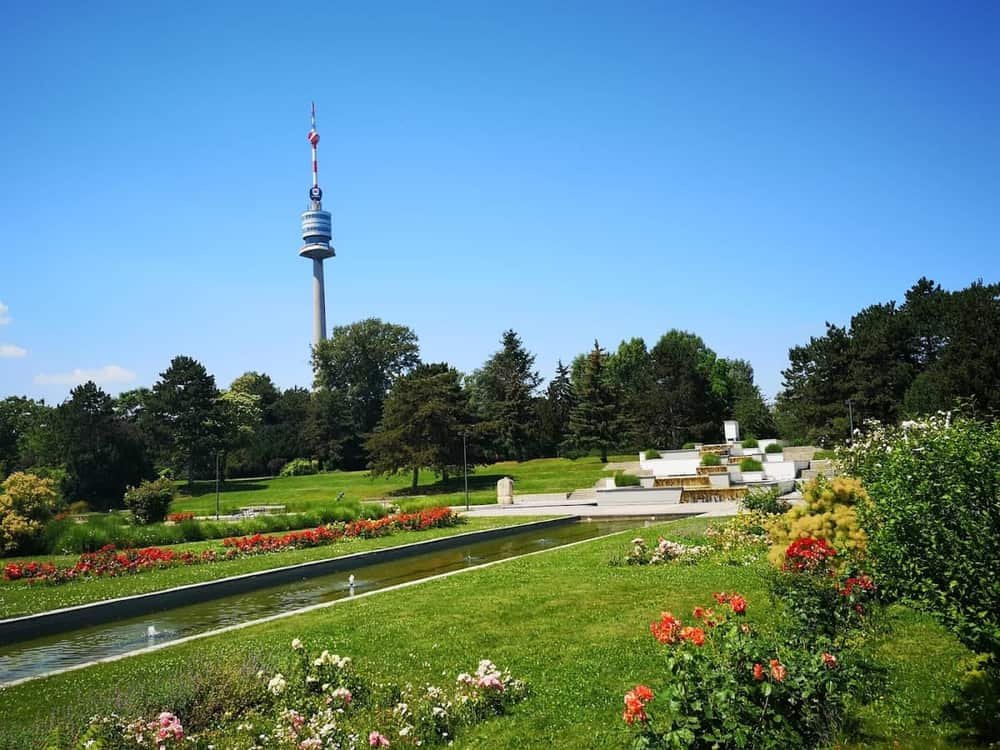
- UNO City and the Donaupark. Take the U1 to Kaisermühlen-VIC. Guided tours of the Vienna International Centre are offered by the UN visitors' service; book ahead and bring photo ID. Afterwards, walk into the Donaupark and ride up the Danube Tower, 150 metres high with express lifts (donauturm.at, checked September 2026), for a view over UNO City, the Danube and the modern skyline of Donau City, including DC Tower 1, home of the Meliá Vienna.
- The Belvedere. The Marble Hall of the Upper Belvedere, where the State Treaty was signed.
- The Hofburg and Heldenplatz. Congress of Vienna, SALT II, the OSCE — and on Heldenplatz the balcony from which Hitler announced the Anschluss in 1938, a reminder of what neutrality was meant to prevent.
- Schwarzenbergplatz. The Soviet War Memorial.
- Palais Coburg. Pass by the nineteenth-century palace on the old city bastion where the Iran deal was concluded.
To continue across the river, combine UNO City with a swim or a walk on the Donauinsel or the Alte Donau, and see Vienna beyond the centre for more reasons to leave the Ring. For how the U-Bahn made this riverside district possible, read the history of Vienna's public transport.
Where to stay nearby
Live prices and availability on a map centred on this exact spot — hotels, apartments and hostels, so you can judge the walk from here rather than guess from an address.
Bookings made through this map earn us a commission. Your price is unaffected.